Wednesday, September 25, 2024

Questions SEP 26

GT 3.15--3.20 (thru True Cost...). WW 226-265. McK thru E.B. White... PH -33 Foreword... Oceans. 

Midterm report presentations continue: 26 - Alex Wiseman; Gray Fogo

From last time Don't worry: if we fall further behind with our questions I'll catch us up with an audio review before the exam.):

  • What form of magical thinking for climate could become a new theology? 200-01
  • What's the main lesson from the church of technology? 
  • Critics of Al Gore are calling attention to what, in the words of Thomas Piketty? 207  Do you agree that policy change is more urgent than personal choices?
  • How do Mann and Wainwright re-purpose Thomas Hobbes? 212
  • What's the wheat myth, according to Yuval Noah Harari? 219  Are you going to read his new book Nexus?*  Do you agree that our era is a "blip..."? 220
  • What kind of time does climate change threaten to impose? 224
McK

  1. What did poet Robinson Jeffers identify as the modern disease? 251  What do you think of Tor House?
  2. COMMENT?: “The quality of owning freezes you forever in "I," and cuts you off forever from the "we.”
    ― John Steinbeck, The Grapes of Wrath
  3. What would Bill McKibben prefer as our national anthem? 258 
  4. Prior to the Parkland shooting, what was Marjory Stoneman Douglas most known for? 260
  5. How does McKibben characterize Aldo Leopold's "land ethic"? 265
  6. Please post your discussion questions

Again, please post your discussion questions (and responses) pertaining to these:

GT

  1. What is the Reflorestarmentes platform? On what demographic does it especially rely? 176-7
  2. Why does Greta call Democracy our most valuable tool? What do we need, to deploy it effectively in the climate crisis? 180-81
  3. Why do poor populations tend to be more harmed by climate change? 183
  4. Under what conditions would Taikan Oki consider moving to Stockholm? 186
  5. What are some literary illustrations of how climate conditions can exacerbate human behavior? 188-9
  6. What was the message of 2008? 193
WW
  1. What is NTHE, and what does WW find problematic about it? 227
  2. What bias do some technologists and de-extinction advocates say we should discard? 230
  3. What did Robinson Jeffers call his philosophy? What did Charles Taylor call it? 231-2
  4. Why does Paul Kingsnorth propose to "withdraw"? 234
  5. To what "clearheaded calculus" do climate alarmists like WW attribute their alarm? 237
  6. At what kind of despair does novelist Richard Powers point? What response does he prefer to withdrawal? 239 (Powers' latest book Playground just came out, btw.)
  7. What does WW mean when he says the portrait of suffering he's presented in this book is "elective"? 244
  8. How is global warming a "Fermi solution"? 246
  9. What's the point of Adam Frank's thought experiment? 248
  10. Why does WW think we might be wise to consider ourselves cosmically special? 250-1
  11. "You can choose your metaphor." 253 Which do you prefer?
  12. What encouraging developments coincided with the UN's "Doomsday" report? 257-260
  13. Do you agree with WW's hope for a happier future? 265
McK
  1.  How did people used to speak dismissively of smog? 295 (btw: two famous baseball players hailed from Donora PA, can you name one?)
  2. What famous naturalist drove his Buick 17,000 miles to follow the seasons? -And said, 

    "Change is a measure of time and, in the autumn, time seems speeded up. What was is not and never again will be; what is is change." 313

  3. What did the Nearings find perverse about "making money" and "getting rich"? 320

  4. What experiences gave Sigurd Olson a transcendent feeling of freedom and detachment? 324

  5. What was E.B. White's amendment to the strength=freedom doctrine? (And: what do you think of his statement that “I arise in the morning torn between a desire to improve (or save) the world and a desire to enjoy (or savor) the world. This makes it hard to plan the day.” Or his letter to a despondent citizen who'd begun to lose hope in the human future? --"Hang on to your hope. And wind the clock, for tomorrow is another day.")


PH*

  1. Have you visited www.regeneration.org? Impressions?
  2. COMMENT on Jane Goodall's foreword? Do you agree that the climate crisis is interconnected with and insoluble apart from issues of poverty, health care, social justice etc.? Do you share her three reasons for hope? 6-7
  3. Do you see the proposal to put "the future of life at the heart of everything we do" as consistent with the urgency of addressing "current human needs, not future existential threats" and an "imagined dystopian future"? 9-10
  4. Are you confident that we'll be "going in the right direction at the right speed by 2030"? 10 If not, will you nonetheless engage the crisis and assert your agency?
  5. COMMENT?: "there is no difference between a climate denier and someone who understands the problem but does nothing." 11
  6. Do pessimists and defeatists lack imagination? 12
  7. Have you attempted to exert influence "upstream"? Will you? 13 
  8. Does anything in the Readers Reference Guide surprise you? 14-15
  9. Will we "cease using the ocean as a dump" anytime soon? 17
  10. Will we stop using the ocean as a "lawless commons" anytime soon? 19
  11. Are too many academics (like Enric Sala, formerly) effectively writing obituaries for life on earth rather than working for solutions? 20
  12. Should we be seeding more kelp forests and consuming more seaweed? 23-4
  13. Did you realize how rapidly the mangrove forests had declined in just the past forty years? 27
  14. Do you think developers realize or care how badly they're compromising the tidal salt marshes and seagrasses? 29-31
  15. Why are we not better at learning from and retaining the insights of indigenous peoples and ancient scholars like Jia Si Xue? 32


From #DamonGameau, the author of our Afterword: #2040film. An aspirational journey to discover what the future could look like if we simply embraced the best that exists today.


First time I taught Environmental Ethics we read Paul Hawken's Blessed Unrest. He's still hopeful, though he says he "didn't intend it; optimism discovered me."

"We have agency..."

 Confronting Our New Reality

Solutions to the problem of climate change have never been more clear. But the scale of the problem keeps getting bigger.


...Moving forward may well mean advances in the deployment of clean power. It may mean rapid gains in the efficiency of everything from cars to data centers. It may even mean breakthroughs in new forms of power, such as fusion or small-scale nuclear.

But as the catastrophic effects of climate change continue to mount, human ingenuity will have to do much more than get better at delivering energy. It will also have to help humans adapt to life on a hotter planet.

We will need new technologies to manage an atmosphere dense with long-lasting emissions, new solutions to protect vulnerable populations from rising seas, and new strategies for helping nature flourish and agriculture thrive.

"We should not think that we are passive victims of forecasts," Mr. Dyson said. "We actually have agency, we have the tools, and the tools get better every year." nyt

Oceans: Alive & Well?

Alex W's ppt...


(Y'all can post these directly yourselves. Cut out the middleman (me). jpo)

Climate & health

The climate crisis is a health crisis.

The most effective action to slow and reverse ClimateChange is transitioning to renewable energy and moving away from fossil fuels.

Learn more 🔗bit.ly/3TFVSXs #UNGA79

Monday, September 23, 2024

Questions SEP 24

GT 3.8--3.14 (thru Winter...). WW 189-225 (thru History After Progress). McK thru Aldo Leopold...

Presentation: Christina Guest

Good News: keyshop says I now have access to the building after 4:30 pm. So, we can look forward to going out again...when it's not too hot or too loud.

Also: I've bumped Kathryn Modine's "Interconnected Planet" blog up, to just under the NEXT block in the sidebar on the right. Do please read and comment (and share your comments here as well).


GT (please try to formulate and address discussion questions pertaining to the following): 

  1. Greta says 3 billion people in the world use less energy annually than a standard American what? How does that make you feel? 154
  2. What should we be celebrating? And what have we been told to celebrate? 155-6 
  3. What's Greta's definition of hope? 157
  4. Governments have acted ___, not ___. What kind of shift is required, for that to change? What, besides changing our lifestyles, must we do? 159-61
  5. What are sacrifice zones? Who populates them? 163
  6. What is fast becoming the planet's most significant human threat? 166
  7. How many displaced people does the World Bank forecast for sub-Saharan Africa and Southeast Asia by mid-century? 167
  8. The fulfillment of what reasonable expectations is the least we owe the next generation? 170
  9. What should one consider, before deciding anything important? 172
  10. What is "the sun's daughter's" classic hopeful question? 174-5
WW
  1. What's the predominant worldview of entrepreneurs in Silicon Valley? What's their greatest concern? Why is it a "strange evolutionary stage"? 189-90  Are you more hopeful or fearful of AI?
  2. Who is Nick Bostrom and what's on his "big picture risk list"? 191-2  What do you think of transhumanism and posthumanism? Would posthumanity suffer greater social inequities than humanity so far?
  3. What, besides geoengineering, have Peter Thiel and Sam Altman invested in? 192-3  Do you want to be uploaded?
  4. What (besides the name of the X-man) is Elon Musk? 195 Do you want to live on Mars or is a spaceship?
  5. Why hasn't the green revolution happened yet? 196-8  Do you think it will happen soon enough? 
  6. According to the IPCC, we have how many years to halve emissions (bearing in mind that this bookj was published in 2019-20)? 198
  7. What's the second most carbon-intensive industry in the world? 199  (Hope they're working on that in the new building across the parking lot.)
  8. What form of magical thinking for climate could become a new theology? 200-01
  9. What's the main lesson from the church of technology? 
  10. Critics of Al Gore are calling attention to what, in the words of Thomas Piketty? 207  Do you agree that policy change is more urgent than personal choices?
  11. How do Mann and Wainwright re-purpose Thomas Hobbes? 212
  12. What's the wheat myth, according to Yuval Noah Harari? 219  Are you going to read his new book Nexus?*  Do you agree that our era is a "blip..."? 220
  13. What kind of time does climate change threaten to impose? 224
McK
  1. What did poet Robinson Jeffers identify as the modern disease? 251  What do you think of Tor House?
  2. COMMENT?: “The quality of owning freezes you forever in "I," and cuts you off forever from the "we.”
    ― John Steinbeck, The Grapes of Wrath
  3. What would Bill McKibben prefer as our national anthem? 258 
  4. Prior to the Parkland shooting, what was Marjory Stoneman Douglas most known for? 260
  5. How does McKibben characterize Aldo Leopold's "land ethic"? 265
  6. Please post your discussion questions
==
Hidden Brain podcast-

Fighting despair. Every morning, you wake up and face the world. What does it look like to you? Do you see a paradise of endless opportunities, where people are friendly and helpful? Or a world filled with injustice, where people cannot be trusted? In the final installment of this year's You 2.0 series, we talk with psychologist Jamil Zaki about how we become disillusioned and distrustful of the world, and how to balance realism with hope.

==

The Big Big Big Big Big Picture

A big new study zeroes in on our dilemma


"...these temperatures are much higher than anything humans have experienced, and they guarantee a world with radically different regimes of drought and deluge, radically different ocean levels and fire seasons. They imply a world fundamentally strange to us, with entirely different seasons and moods—and if that doesn’t challenge bare survival, it certainly challenges the survival of our civilizations. Unlike all the species that came before us, we have built a physical shell for that civilization, a geography of cities and ports and farms that we can’t easily move as the temperature rises. And of course the poorest people, who have done the least to cause the trouble, will suffer out of all proportion as that shift starts to happen.

But that’s not the really scary part. The really scary part is how fast it’s moving.

In fact, nowhere in that long record have the scientists been able to find a time when it’s warming as fast as it is right now. “We’re changing Earth’s temperature at a rate that exceeds anything we know about,” Tierney said.

Much much much faster than, say, during the worst extinction event we know about, at the end of the Permian about 250 million years ago, when the endless eruption of the so-called Siberian traps drove the temperature 10 Celsius higher and killed off 95 percent of the species on the planet. But that catastrophe took fifty thousand years—our three degree Celsius increase—driven by the collective volcano of our powerplants, factories, furnaces and Fords—will be measured in decades.

Our only hope of avoiding utter ruin—our only hope that our western world, in the blink of an eye, won’t produce catastrophe on this geologic scale—is to turn off those volcanoes immediately. And that, of course, requires replacing coal and gas and oil with something else. The only something else on offer right now, scalable in the few years we still have to work with, is the rays of the sun, and the wind that sun produces, and the batteries that can store its power for use at night.

Another new analysis this week, this one from the energy thinktank Ember, shows that 2024 is seeing another year of surging solar installations—when the year ends there will be 30% more solar power on this planet than when it began. Numbers like that, if we can keep that acceleration going for a few more years, give us a fighting chance.

That’s what all those seminars and cocktail parties and protests in New York over the next week will ultimately be about—the desperate attempt to keep this rift in our geological history from getting any bigger than it must. As this new study once more makes clear, raising the temperature is by far the biggest thing humans have ever done; our effort to limit that rise must be just as large.

We need to stand in awe for a moment before the scope of earth’s long history. And then we need to get the hell to work." Bill McKibben

==

*NEXUS: A Brief History of Information Networks From the Stone Age to AI, by Yuval Noah Harari

In the summer of 2022, a software engineer named Blake Lemoine was fired by Google after an interview with The Washington Post in which he claimed that LaMDA, the chatbot he had been working on, had achieved sentience.

A few months later, in March 2023, an open letter from the Future of Life Institute, signed by hundreds of technology leaders including Steve Wozniak and Elon Musk, called on A.I. labs to pause their research. Artificial intelligence, it claimed, posed “profound risks to society and humanity.”

The following month, Geoffrey Hinton, the “godfather of A.I.,” quit his post at Google, telling this newspaper that he regretted his life’s work. “It is hard to see how you can prevent the bad actors from using it for bad things,” he warned.

Over the last few years we have become accustomed to hare-eyed messengers returning from A.I.’s frontiers with apocalyptic warnings. And yet, real action in the form of hard regulation has been little in evidence. Last year’s executive order on A.I. was, as one commentator put it, “directional and aspirational” — a shrewdly damning piece of faint praise... 

…The threats A.I. poses are not the ones that filmmakers visualize: Kubrick’s HAL trapping us in the airlock; a fascist RoboCop marching down the sidewalk. They are more insidious, harder to see coming, but potentially existential. They include the catastrophic polarizing of discourse when social media algorithms designed to monopolize our attention feed us extreme, hateful material. Or the outsourcing of human judgment — legal, financial or military decision-making — to an A.I. whose complexity becomes impenetrable to our own understanding.

Echoing Churchill, Harari warns of a “Silicon Curtain” descending between us and the algorithms we have created, shutting us out of our own conversations — how we want to act, or interact, or govern ourselves… 
(nyt, continues)

For the last 100,000 years, we Sapiens have accumulated enormous power. But despite all our discoveries, inventions and conquests, we now find ourselves in an existential crisis. The world is on the verge of ecological collapse. Misinformation abounds. And we are rushing headlong into the age of AI – a new information network that threatens to annihilate us. If we are so wise, why are we so self-destructive?

NEXUS considers how the flow of information has shaped us, and our world. Taking us from the Stone Age through the Bible, early modern witch-hunts, Stalinism, Nazism and the resurgence of populism today, Yuval Noah Harari asks us to consider the complex relationship between information and truth, bureaucracy and mythology, wisdom and power. He explores how different societies and political systems have wielded information to achieve their goals, for good and ill. And he addresses the urgent choices we face as non-human intelligence threatens our very existence.

Information is not the raw material of truth; neither is it a mere weapon. NEXUS explores the hopeful middle ground between these extremes, and of rediscovering our shared humanity. g'r
==


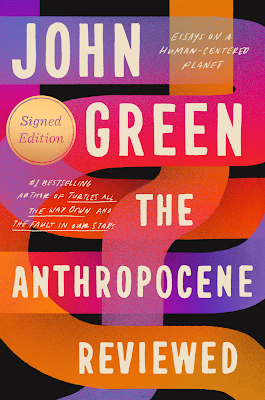
John Green says we shouldn't surrender to apocalyptic despair. Not yet.

 Scientists sound the alarm after Antarctic sea ice reaches unnerving record: 'Last year was outrageous, and it's happened again'

Story by Kaiyo Funaki

https://www.msn.com/en-us/weather/topstories/scientists-sound-the-alarm-after-antarctic-sea-ice-reaches-unnerving-record-last-year-was-outrageous-and-it-s-happened-again/ar-AA1qYiIB?ocid=BingNewsVerp

Researchers are concerned that Antarctica is facing a new reality, with the continent on pace to have historically low sea ice levels for the second year in a row. 

What's happening?

A report from the Guardian detailed the rapidly declining rate at which Antarctica is retaining its surrounding sea ice.   

What can I do to help reverse declining sea ice levels?

Since this issue stems from an overheating planet, anything we do to reduce our overreliance on dirty energy sources that pollute the atmosphere is a positive step. 

Actions with a broad effect, such as donating to your favorite climate organization, are the best place to start. Personal moves can add up, too — try upgrading to electric yard tools or ditching plastic containers to help drive down unnecessary pollution. 

We can also support circular brands that focus on sustainability, including Patagonia, which transitioned to an infinitely recyclable material to repair wetsuits, and Pandora, which now uses only recyclable rare metals for its jewelry. 


To End Poverty and prevent climate catastrophe, electrify the world

…Improved solar panels, batteries and other breakthroughs now make it far easier to provide reliable, clean electrification to everyone. The Oxford Poverty and Human Development Initiative has highlighted the correlation between a lack of electricity access and education, poor health and malnourishment. Electrifying the world could produce the largest development gains since the 1990s.

Electrification is about more than progress for individuals; it makes the world safer and more secure. High energy prices are straining livelihoods at a moment when coups, migration and unrest are destabilizing regions. And because the countries where energy access is lowest are projected to produce as much as 75 percent of greenhouse gas emissions by 2050, connecting people there to clean energy can help prevent climate catastrophe for us all...


https://www.nytimes.com/2024/09/22/opinion/clean-energy-electricity-poverty.html?smid=nytcore-ios-share&referringSource=articleShare&ngrp=mnp&pvid=F080DEE2-48AB-4C21-9B7F-E2C1F6E47FEC

Two Outer Banks Homes Collapse Into the Ocean in North Carolina

…The most recent collapse is the ninth in Rodanthe in the past four years. Four of those collapses took place this year.

For those on the Outer Banks, the destruction has been a stark reminder of the larger force at play — climate change, which is making storms more intense and sea levels higher, accelerating the erosion of beach fronts.

One property that fell into the ocean last month may have collapsed because of the powerful waves produced by Hurricane Ernesto hundreds of miles away, in addition to high tides.

A combination of winds, waves, tides, rising seas and more intense storms have contributed to coastal erosion, especially in the villages of Rodanthe and Buxton, N.C., which are adjacent to the seashore, park officials said...


https://www.nytimes.com/2024/09/22/us/north-carolina-house-collapse-rodanthe.html?smid=nytcore-ios-share&referringSource=articleShare&ngrp=mnp&pvid=067FA2A6-3CA3-4D58-9D4C-6816CB07E9BC

The World Is a Mess. That Makes the Climate Crisis Harder to Solve.

Global power is fractured. Temperatures have risen to record levels. Bitterness and anxiety are rising in vulnerable countries lashed by deadly heat and floods.

This week, as presidents and prime ministers assemble at the United Nations General Assembly, they confront a vastly different world from the one that existed nearly 10 years ago, when nations rich and poor found a way to rally together around a remarkable global pact.

In that agreement, the 2015 Paris accord, they promised to act and acknowledged a bare truth: Climate change threatens all of us, and we owe it to each other to slow it down. Countries agreed to nudge each other to raise their climate ambitions every few years, and the industrialized nations of the world — which had prospered from the burning of coal, oil and gas — said they would help the rest of the world prosper without burning down the planet.

Turns out, geopolitics can be as unpredictable as the weather.

Three big things have shifted since the climate accord that, together, have sunk the prospects of global climate cooperation to a low point. China has raced ahead of every other country, including the United States, to dominate the global clean-energy supply chain, fueling serious economic and political strains that undermine incentives to cooperate. Rich countries have failed to keep their financial promises to help poor countries shift away from fossil fuels. A widening gyre of war — from Ukraine to Gaza and now, in Lebanon — has become an impediment to global climate consensus...


https://www.nytimes.com/2024/09/23/climate/climate-diplomacy-fracture.html?smid=nytcore-ios-share&referringSource=articleShare&ngrp=mnp&pvid=B7DA9EF6-4A43-44B5-B00B-50C4EAB0A5DE

They’ve Got a Plan to Fight Global Warming. It Could Alter the Oceans.

In a quiet patch of forest in Nova Scotia, a company is building a machine designed to help slow global warming by transforming Earth's rivers and oceans into giant sponges that absorb carbon dioxide from the air.

When switched on later this year, the machine will grind up limestone inside a tall green silo and release the powder into the nearby West River Pictou, creating a chalky plume that should dissolve within minutes.

The effect could be potent, scientists say. Rivers contain carbon dioxide that is constantly escaping into the air, where it traps heat and warms the planet. But adding limestone converts some of that carbon dioxide into a stable molecule that instead stays underwater and washes into the sea, where it should remain trapped for thousands of years.

"The beauty of it is how simple the technology is," said Eddie Halfyard, a freshwater ecologist and co-founder of CarbonRun, the start-up building the $400,000 limestone machine, with plans for many more. "We let the water do most of the work."

With the dangers of climate change growing and greenhouse gas emissions soaring, scientists and entrepreneurs are increasingly exploring ways to deliberately intervene in climate systems to cool the Earth. Overwhelmingly, scientists say nations must sharply cut the pollution from burning fossil fuels that is driving up global temperatures. But many also believe that some of the excess carbon in the atmosphere must also be pulled out in order to preserve a livable planet.

"The potential for ocean-based carbon removal is huge, and it's been really underexplored," said Nan Ransohoff, who heads Frontier, a $1 billion fund backed by tech giants like Stripe and Alphabet that is investing heavily in strategies to take greenhouse gases out of the atmosphere...


https://www.nytimes.com/2024/09/23/climate/theyve-got-a-plan-to-fight-global-warming-it-could-alter-the-oceans.html?smid=nytcore-ios-share&referringSource=articleShare&ngrp=mnp&pvid=CBA1AC06-4A8C-453B-A828-8E3DB1048F69