Wednesday, November 6, 2024

Final report presentations

We'll do two or three presentations per class. I've tentatively filled out the schedule, most of you haven't indicated a preference. You can swap with someone else if they're agreeable, just put that in the comments space and give me a heads-up. There were no volunteers to go first on November 5 so we'll have to do three presentations in a couple of classes.


Presentation to be complemented with a final report blog post due Dec.6. Everyone will need to sign up as an AUTHOR on this site, in order to post, before then. Post an early draft for constructive feedback or to use in your presentation. The blog post should summarize your presentation, and elaborate on it. Include relevant links (instead of footnotes/bibliography) to sources.


    NOV 5 [Don't forget to vote!]

    • Greta Thumberg, The Climate Book (GT) 5.15--5.21 (thru Mending...Earth)
    • Bill McKibben, American Earth (McK) thru Terry Tempest Williams


    NOV 7 

    • GT 5.22 (Hope... What Next?) - Eli Miller
    • McK thru Ellen Meloy - Alex Wiseman


    NOV 12

    • William MacAskill, What Do We Owe the Future? (MacA) Part I-The Long View - Aidan Haines
    • McK thru Jack Turner - Gray Fogo


    NOV 14 

    • MacA Part II-Trajectory Changes Christina Guest
    • McK thru David Quammen - Audrey Lewis
    • ... - Eli Miller


    NOV 19 

    • MacA Part III-Safeguarding Civilisation - Eli Kersey
    • McK thru Sandra Steingraber - Nathan Ruppel
    • Quammen, "Earth's biological limits" - Chelsie Gordon


    NOV 21 

    • MacA Part IV-Assessing the End of the World - Katherine Welch
    • McK Barbara Kingsolver, Michael Pollan - Jonathan Keith


    NOV 26

    • MacA Part V-Taking Action - Martin Stricklin
    • McK Paul Hawken, Rebecca Solnit - Molly Carico
    • Gary Wedgewood


    [Nashville Scene] Transit Referendum Passes

    Nashville voters have cast their ballots in favor of a new transit plan designed to improve buses, upgrade traffic lights, build sidewalks and more. Speaking at co-working space The Malin in the Gulch, O'Connell declared victory after early-voting results showed overwhelming support for the measure.

    "There have been people carrying the torch for this conversation for such a long time," O'Connell told his supporters. "We all came together for the past couple months to do something good, big, important and popular."

    The plan calls for $3.1 billion in spending over the next 15 years. Funds would go to improvements to the public WeGo bus system, constructing sidewalks, upgrading traffic lights and more. The "Choose How You Move" plan will be funded by a half-cent increase to the sales tax. The mayor and transit advocates say having a dedicated funding source will help Nashville apply for and receive federal grants for transportation improvements in the future....

    https://www.nashvillescene.com/news/pithinthewind/transit-referendum-passes/article_0536c994-9bb6-11ef-b153-ef194d748ffa.html?utm_medium=social&utm_source=email&utm_campaign=user-share

    What Trump’s Victory Means for Climate Change

    President-elect Donald J. Trump promised to delete climate policy. He could face pushback from Republicans benefiting from a boom in clean energy.

    The fight against climate change has taken a body blow with the election of Donald J. Trump, who calls global warming a "scam" and has promised to erase federal efforts to reduce the pollution that is heating the planet.

    Mr. Trump told a jubilant crowd Wednesday that the United States, which signed a global agreement last year to transition away from fossil fuels, will instead amp up oil production even beyond current record levels. "We have more liquid gold than any country in the world," said the president-elect, who won with substantial financial support from the oil and gas industry. "More than Saudi Arabia. We have more than Russia."

    But Mr. Trump's zeal to repeal the 2022 Inflation Reduction Act, the landmark climate law that is pouring more than $390 billion into electric vehicles, batteries and other clean energy technology, will quickly face a political test.

    Roughly 80 percent of the money spent so far has flowed to Republican congressional districts, where lawmakers and business leaders want to protect that investment and the jobs they bring...


    https://www.nytimes.com/2024/11/06/climate/trump-climate-change.html?smid=em-share

    Climate science pioneer Warren Washington

    Warren Washington, Groundbreaking Climate Scientist, Dies at 88

    He invented a computer model that made it possible to measure human-induced climate change. He also helped break a color barrier in science.

    Warren M. Washington, a scientist who helped invent one of the first computer models of the earth’s atmosphere, paving the way to accurately measure human-induced climate change, died on Oct. 18 at his home in Denver. He was 88.

    His death was confirmed by a spokesman for the National Center for Atmospheric Research, where Dr. Washington was a senior scientist and had worked for more than 50 years.

    Dr. Washington was a pioneer in two senses.

    The son of a Pullman-car porter in Portland, Ore., he became the second Black student in the United States to receive a Ph.D. in meteorology.

    He was also one of the country’s first and most influential climate scientists, advising five presidents on climate change and serving as a mentor to generations of researchers who followed him... (continues)

    Tuesday, November 5, 2024

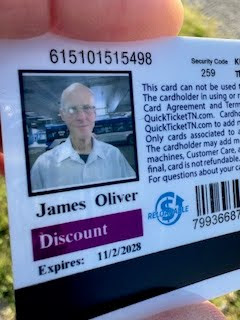
    Almost on the bus

    A step closer to becoming a responsible transit patron.

    No pressure, but

    The Future of the Planet Hangs on This Vote

    "In thinking about climate change, I often feel desperate, but in talking with others I try not to lead with despair. Like all human emotions, despair is contagious. Worse, it leads to immobility, and we have run out of time for hand-wringing. If ever we must resist the temptation to fall into despair, surely it is now, with the election polls so close and the future of the planet hanging on what happens Tuesday.

    A lot of other things hang on what happens Tuesday, too, as The Times has deeply reported over the last weeks in a series called "What's at Stake in the 2024 Election." As president, Donald Trump could destroy the stability of our institutions, including American democracy itself. He could further trample women's reproductive safety and autonomy, terrorize immigrant Americans, roll back hard-won rights for L.G.B.T.Q. people, imperil what's left of the impartiality of the courts and weaponize government to prosecute anyone he perceives as an enemy, end all hopes for curtailing gun violence, close off access to affordable health care, threaten the free press, and fray the social safety net in all its forms. And that's just the beginning of an almost limitless list of dangers he poses.

    Of them all, the one that most often keeps me up at night is the way a second Trump presidency would imperil the planet. Climate change, which Mr. Trump calls "a scam," is a threat multiplier: Every existing global conflict, every human vulnerability and every form of social instability is already being exacerbated by climate calamities. There is no issue on the political table that will not be made exponentially worse if we allow the living earth to enter its death throes, and yet climate has rarely been part of the political discourse during this election year..."

    Margaret Renkl, continues

    Words matter

    In low moments, I sincerely doubt that anyone ever changes their mind, and I especially doubt that anyone ever changes their mind in response to an op-ed. But our planet, our home, is in mortal danger, and words are all I've got. So I'm taking my very best shot here.

    Margaret Renkl

    https://www.nytimes.com/2024/11/04/opinion/trump-harris-election-climate.html?unlocked_article_code=1.XU4.g3Yl.LHkfOgVHkiRB&smid=nytcore-ios-share&referringSource=articleShare

    Monday, November 4, 2024

    Experts uncover 'game-changer' side effects of solar farms: 'The benefits are numerous'

    Jeremiah Budin  11 3 2024

    The solar energy industry has long been portrayed as being at odds with traditional farming, as both require lots of land and are presumably in competition with one another.

    However, a new approach called "agrivoltaics" is integrating the two industries together and showing that they can coexist while benefiting one another, the Washington Post reported.

    Agrivoltaics essentially allows farmers to lease parts of their land to solar companies, providing the farmers with steady, guaranteed incomes. Best of all, the land underneath the solar panels is still theirs to use for things like grazing or for plants that require lots of shade. Even if sellable crops aren't plantable under the solar panels, farmers can still install native plants and flowers that support local pollinators, in turn supporting their other crops.

    "If they are managed well, [agrivoltaic farms] are increasing biodiversity, sequestering carbon and increasing soil organic matter. The benefits are numerous," said Loran Shallenberger, senior director of regenerative energy operations for Silicon Ranch, a Nashville, Tennessee-based solar energy company.

    The farmers that have bought into this business opportunity — at least the ones the Post spoke to — seem very happy with their decision. One was using a portion of his family farm for "solar grazing," in which sheep graze under the solar arrays.

    "You're getting paid to graze your sheep," he said.

    If cattle farmers were to also embrace agrivoltaics en masse, that could make a huge difference for the solar industry and for our planet, as cattle farming is much more prevalent than sheep farming in the U.S. (although with its own environmental drawbacks).

    As our planet continues to overheat largely as a result of the air pollution created by dirty energy companies, it is clear that we need to switch away from energy sources like gas and oil and toward clean, renewable sources like wind and solar as quickly as humanly possible.

    https://www.msn.com/en-us/money/other/experts-uncover-game-changer-side-effects-of-solar-farms-the-benefits-are-numerous/ar-AA1toXsM?ocid=BingNewsSerp

    Whistleblowers make alarming claims about decades-long efforts to mislead public: 'Uniquely dangerous and underregulated'  "They could be lethal."

    by Mike Taylor  November 3, 2024  The Cool Down Company, TCD Newlsetter

    Oil and gas companies' disinformation campaigns about the effects of dirty fuels on the climate have been ongoing for years — and despite statements to the contrary discussed in a new investigation, the industry is not part of the solution to rebalance our rapidly warming planet.

    What's happening?

    Oil and gas corporations are touting their role in fixing the climate crisis, but a federal investigation and whistleblowers indicate it's all for show, Vox reported with Drilled. 

    Issues include misleading information surrounding the overarching benefits of carbon capture and storage, as well as enhanced oil recovery — which are being marketed as solutions and even ways to lead the United States' efforts to cut heat-trapping pollution. 

    Continues at:  https://www.msn.com/en-us/weather/topstories/whistleblowers-make-alarming-claims-about-decades-long-efforts-to-mislead-public-uniquely-dangerous-and-underregulated/ar-AA1toXBm

    Sunday, November 3, 2024

    “the biggest climate election ever”

    "For my January 2021 piece on America's path to sustained climate progress, I noted that early overreach by Joe Biden wasn't the way, and that a key would be to build legislation stimulating community resilience, innovation and clean-energy expansion. I also said it'd take one Biden term and two Kamala Harris terms. And here we are, after the Bipartisan Infrastructure Law and IRA, poised for Harris term one if blue voters surge. That indeed makes this the biggest climate election ever…"1/2

    Andrew Revkin

    https://www.threads.net/@andrew_revkin/post/DB6QOCLOGsC?xmt=AQGz9DuMZx7jMnjY2v8dErXbORGKF_i0rKiSmpIumo0bmg

    Friday, November 1, 2024

    Questions NOV 5

    GT 5.15--5.21 (thru Mending...Earth). McK thru Terry Tempest Williams. 

    Final report presentations begin: Volunteer?

    GT

    1. Greta says the climate crisis is part of what larger crisis? 389
    2. What's the deeper problem with "silos"? 390
    3. What more, besides her five planks, does Naomi Klein say justice-based climate action demands? 391, 394
    4. What does equity mean to Nicki Becker, Disha Ravi, Hilda Flavia Nakabuye, and Laura Munoz? 396-9
    5. Wanjira Mathai says we're called to what? 404
    6. What is the emissions ratio between the richest and poorest Americans? 406
    7. What kind of project is justice, according to Olufemi Taiwo? 413
    8. Robin Wall Kimmerer observes a correlation between mental health and what? 416
    9. What root is shared by the words ecology and economy? 419
    10. What does Kimmerer see as one of the great gifts of Indigenous environmental philosophy? 420
    McK
    1. What terrifying message did Alice Walker take from the trees? Where does she say fear of nature leads us? 662-3
    2. What does Walker admire about the Native Americans? 668
    3. E.O. Wilson's Biophilia proposed what? 
    4. Wilson thinks all our troubles may arise from what, to be remedied how? 687
    5. COMMENT?: Wilson's Half-earth Project... The Creation... sociobiology and subsequent controversies... his last word...
    6. What major health threats from California grapes did Cesar Chavez identify? 692-3
    7. Who was not present (so far as Barry Lopez knew) for the whales' demise? 715 Is that lamentable? Why?
    8. What was W.S. Merwin angry about? 716
    9. What idea does Bill McKibben say we've ended? 719f.
    10. What movement has Robert Bullard's work helped birth? 725
    11. COMMENT? Photos between pp.736-7
    12. What's your response to Mary Oliver's "Summer Day"? 737-8
    13. How did Terry Tempest Williams's grandmother define copious and scrupulous? 748

    Bill McKibben on The End of Nature in 2015:


    Wednesday, October 30, 2024

    Resources, and if you want to talk about it

     If anyone would like to talk about the tragedy on Monday, feel free to comment here or in class. 


    "It must be recognized that staying alive though suicidal is an act of radiant generosity, a way in which we can save each other.  
    ...
    None of us can truly know what we mean to other people, and none of us can know what our future self will experience. History and philosophy ask us to remember these mysteries, to look around at friends, family, humanity, at the surprises life brings — the endless possibilities that living offers — and to persevere. There is love and insight to live for, bright moments to cherish, and even the possibility of happiness, and the chance of helping someone else through his or her own troubles. Know that people, through history and today, understand how much courage it takes to stay. Bear witness to the night side of being human and the bravery it entails, and wait for the sun. If we meditate on the record of human wisdom we may find there reason enough to persist and find our way back to happiness. The first step is to consider the arguments and evidence and choose to stay. After that, anything may happen. First, choose to stay.”  --Jennifer Michael Hecht, Stay: A History of Suicide and the Philosophies Against It
    ==

    Stay: The Social Contagion of Suicide and How to Preempt It
    By Maria Popova

    "If you’ve ever known someone who committed suicide, or have contemplated it yourself, or have admired a personal hero who died by his or her own hand, please oh please read this. Because, as Jennifer Michael Hecht so stirringly argues in Stay: A History of Suicide and the Philosophies Against It (public library), numerous social science studies indicate that one of the best predictors of committing suicide is knowing suicide — a fact especially chilling given more people die of suicide than murder every year, and have been for centuries. Suicide kills more people than AIDS, cancer, heart disease, or liver disease, more men and women between the ages of 15 and 44 than war, more young people than anything but accident. And beneath all these impersonal statistics lie exponential human tragedies — of those who died, and of those who were left to live with their haunting void.

    To be sure, Hecht’s interest in the subject is far from the detached preachiness such narratives tend to exude — after two of her dear friends, both fellow writers, committed suicide in close succession, she was left devastated and desperate to make sense of this deceptively personal act, which cuts so deep into surrounding souls and scars the heart of a community. So she immersed herself in the science, philosophy, and history of suicide searching for answers, emerging with an eye-opening sense of everything we’ve gotten wrong about suicide and its prevention..." (continues)


    Questions Oct 31

    PH -255 Industry, Action + Connection, Afterword. GT 5.10--5.14 (thru Lessons from the Pandemic). McK thru William Cronon

    Select your final report topics...


    GT

    1. "People power" is also known as what? 364
    2. The tipping point for changing a society's behavior is what? 367
    3. Why does George Monbiot blame media for major responsibility in destroying life of earth? 369
    4. What alternative media does Monbiot favor? 371
    5. What new tactics have fossil fuel companies and their lackeys adopted? 372-3
    6. What are the markers of emergency mode, in responding to the climate crisis? 375f.
    7. What lessons should the pandemic have taught us? 382-3

    McK

    1. Louise Gibbs' fight over Love Canal led to what? 609
    2. What question does Jonathan Schell say was never asked before our time? 624 Where does he say we must seek the meaning of extinction? 626 
    3. What did Hannah Arendt say about "the common world"? 627
    4. What did Edmund Burke say about the "partnership" of the generations? 630 
    5. For what did Amerian Indian men mock Englishmen? 656

    PH

    1. What will it take to produce a "corporate shift" that credibly addresses the climate crisis? 215

    2. Revisiting this embarrassing question: how many of Michael Pollan's "foodlike substances" do you confess to enjoying? How many have you given up? How many will you give up? 217

    3. Do you consciously factor the "true cost of junk food" into your eating choices? 218

    4. How far are we from "the food system of the future"? 219

    5. If the US political system continues not to acknowledge universal healthcare as a "fundamental human right," do you expect that to precipitate an eventual and radical change in voters' attitudes and choices? 221

    6. Is it still a very tiny percentage of people who think "holistically about every facet of human well-being" or is that changing rapidly with the rising generation? Will or would that significantly impact our healthcare system, the pharmaceutical industry, and the perceived link between climate and health? 222

    7. Do you know where your bank invests your money? Will the Good Money model "fundamentally change the system of banking"? 225

    8. Has the social media environment permanently crippled the prospects of mutualism as a corrective for human aggression? 227

    Startup shakes up industry with revolutionary wind turbine design backed by Bill Gates — here's what it's capable of

    Jon Turi  www.thecooldown.com

    October 27, 2024

    A floating offshore wind energy startup called Aikido is preparing to launch its innovative new platform this fall.

    The company, which is being funded by Bill Gates' Breakthrough Energy for its pilot project, recently added another $4 million from an investment round, as Windpower Monthly reported.

    A recent company news release said the initial funding put the company on track this fall to launch its Aikido One platform, which aims to solve a variety of issues, including assembly and transport, that are common stumbling blocks in the industry.

    The company will use the new funding "to advance its technology for offshore deployment, build its team, and develop a commercial pipeline," per the release.

    "Floating wind must become commercialized by the end of the decade so that we can meet decarbonization targets set by pioneering offshore wind countries," said Sam Kanner, CEO of Aikido Technologies, per the release.

    "We believe that our technology suite represents a step change in reducing costs, simplifying logistics, and increasing throughput of floating wind systems."

    Monday, October 28, 2024

    Questions Oct 29

    PH -213 Energy. GT 5.1--5.5 (thru Changing Diets).GT 5.6--5.9 (thru Practical Utopias). McK thru Wes Jackson. Midterm report presentations conclude - Molly Carico. Select your final report presentation date/topic-indicate your preference(s) after Monday Oct 28

    GT

    1. Why'd Greta stop flying? What's the word for that? What other new word does she prefer? 325
    2. What are some examples of climate-targeted contagion? What has growing enthusiasm for plant-based diets led to? 329
    3. What's Freudian psychology got to do with advertising and public relations? 332
    4. The New Economic Foundation identifies what five promoters of human well-being?? 335 Do you agree with their list? How about Take the Jump's six principles? The five D's? 337
    5. Besides those mentioned on 339, what are some of your favorite climate-related websites? What sort of active leadership is displayed there?
    6. To significantly ameliorate our environmental challenges we need to tweak what? 341 
    7. Ocean-based climate solutions could provide what percentage of greenhouse gas emission reductions? 347
    8.  What percent of the earth's land surface is ecologically intact? 350
    9. Greta says only who can create the social transformation we need? 359
    10. What are Stroud's four elements of survival? 363

    McK

    1. N.Scott Momaday says what conviction is very old in the Native American world view? It is rooted in what sort of act? 579-80  Should we, can we (or enough of us) appropriate this ancient ethic in our time, do you think?
    2. What lie had Tayo learned  by heart? 589
    3. Any comment on R. Crumb's "Short History of America"? 591f.
    4. A town population of what seems to Wes Jackson to have a special energy? 598

    PH

    1. Given the current relative percentages of CO2 emissions from fossil fuels and energy derived from renewables, does this feel to you like "a momentous turning point in civilization"? 193


    2. If "2% of the planet's wind would power all of civilization," would we be stupid and self-destructive NOT to move aggressively towards greater utilization of wind energy? 196

    3. Can we "plug the leaks and close the loop" like Wildpoldsried" 200

    4. Considering how many more EVs are now in operation than just a decade ago, are you confident that transport via internal combustion is on its way out? 202

    5. Do you have a heat pump? Shouldn't everyone? Should we be taxed to subsidize their installation? 205

    6. Were you aware of how wasteful cruise ships are? Will that keep you off of them? 209

    7. Are you confident we can overcome the problematic issues invovled with lithium-ion batteries? 211

    8. Might the "extreme climate benefit" of microgrids also be a social benefit, enhancing the communal consciousness of those whose homes are thus connected? 213

    ==

    Saturday, October 26, 2024

    New report finds one major energy source breaking records worldwide: 'Growing faster than people expected'

    Sam Westmoreland, msn.com, Oct. 25, 2024

    As we continue to push toward greener energy around the world, one source has blown past all expectations: solar.

    According to Electrek, solar energy is on track to exceed most industry forecasts about output and new construction, with a projected 593 gigawatts expected to be added by the end of 2024. This is a 29% increase in production, an amount that surpasses the vast majority of projections.

    "Yet again, solar power is growing faster than people expected, as it establishes itself as the cheapest source of electricity globally," Euan Graham, electricity data analyst at Ember, said.

    In fact, the current projections are nearly 200 gigawatts higher than what the International Energy Agency predicted for solar growth in 2024, which led to revised projections in June. However, according to Ember, the industry is on track to exceed even those revised expectations.

    To put solar's incredible growth into perspective, the industry's growth this year alone exceeds all new output from planet-dirtying coal since 2010.

    The vast majority of the growth in the industry is coming from China; according to the report, they are on track to add 334 gigawatts, or 56% of global new solar power additions, to their grid by the end of 2024. India, the United States, Germany, and Brazil are also some of the biggest growth markets for solar power.

    But other markets are growing as well; according to Ember's report, via Electrek, countries like Saudi Arabia, Thailand, Pakistan, Oman, the Philippines, and the United Arab Emirates all saw sizable growth in their solar installations this year.

    A big part of the growth of solar is the advancement of solar technology. Scientists recently found a way to recycle the materials from old panels, an issue that has long plagued the industry. Meanwhile, researchers also unveiled a new solar cell glass that can absorb energy, as well as roof tiles designed to interface directly with heat pumps to keep your house's temperature regulated.

    https://www.msn.com/en-us/money/other/new-report-finds-one-major-energy-source-breaking-records-worldwide-growing-faster-than-people-expected/ar-AA1sWqYv?ocid=BingNewsSerp

    Friday, October 25, 2024

    Federal agencies ordered to use ‘most powerful’ AI systems in first-ever National Security Memo on AI

    By Stephen Sorace, Fox News 10/24/2024

    The U.S. National Security Council released on Thursday its first-ever memo on artificial intelligence (AI), ordering federal agencies to use the "most powerful" AI systems while balancing the risks associated with the new technology.

    The National Security Memorandum (NSM) details the U.S. approach to harnessing the power of AI for national security and foreign policy purposes "to ensure that America leads the way in seizing the promise and managing the risks of AI," senior administration officials said.

    "We are directing that the agencies gain access to the most powerful AI systems and put them to use, which often involve substantial efforts on procurement," the officials said.

    The NSM, which was signed by President Biden, serves as the framework for the AI Safety Institute in the Department of Commerce, which already issued guidance on safe AI development and entered into agreements with companies to test new AI systems before they are released publicly.

    "This is our nation’s first-ever strategy for harnessing the power and managing the risks of AI to advance our national security," national security adviser Jake Sullivan said as he described the new policy to students during an appearance at the National Defense University in Washington.

    U.S. national security adviser Jake Sullivan said the framework will help the U.S. harness the power of AI while managing the risks that the emerging technology poses. Getty Images

    Recent advances in artificial intelligence have been hailed as potentially transformative for a long list of industries and sectors, including military, national security and intelligence.


    Thursday, October 24, 2024

    The best of '23

     Bill McKibben's excellent introduction to The Best American Science and Nature Writing 2024, focusing heavily (as you might expect) on climate change and its human implications.

    Questions OCT 24

    PH -191 Food. GT 4.23--4.27 (thru Perception Gap). McK thru Amory Lovins...

    Presentation - Martin Stricklin


    NOTE: As midterm report presentations conclude, you can assume that you earned all 25 available points if I've not told you otherwise. The sign-up for final report presentations will be available next week.


    GT

    1. Greta says we can no longer reach our climate targets without what? 301
    2. The Paris Agreement is the world's biggest what? 305
    3. Nicholas Stern says much economic analysis has grossly undervalued what? 307
    4. Why, according to Sunita Narain, is the Paris Agreement lauded? 308
    5.  What do we need to decide about economic growth? 312
    6. What crucial issues are rarely discussed at climate conferences? 315
    McK
    1. Annie Dillard says every egg is what? 532
    2. What couldn't Russell tell his cabbie? What's Dillard's answer? 539-40
    3. Evolution loves ___ more than it loves us. 545  What's our pact with "the devil"? 549
    4. What does the sky do for us? 553
    5. What activist organizations was David Brower associated with? 554
    6. What are the defining characteristics of soft technologies? 560-61
    7. Post your comments...


    PH


    1. Do you think you have "lost your taste"? 171 Have you taken steps to regain it? Do you consume too much "junk"? Do you view eating as an ethical act?

    2. Do you do anything in particular at home to avoid or rectify food waste? 173

    3. Have you begun deliberately to eat fewer processed substances and more plant-based alternatives? 175  

    4. Have you localized your diet, to greater or lesser extent? Do you or will you patronize CSAs?
    177

    5. Should public schools be fast food-free? 179 Should MTSU get rid of, or at least improve the nutritional contents of, vending machines on campus?

    6. Does the Cobbs' story remind you of Wendell Berry? 180

    7. Are you grateful for the decommodification of coffee, beer, and other products? 181 Are you boycotting any Big Commodity products?

    8. How do you feel about ants and other insects? Do you use insecticides, biocides, weed killers etc.? Do you resent the failure of early education to impress upon every student the vital role they play in ecosystems?


    9. Do you think restoring the American chestnut is a good idea, without the frivolity or uncertainty of restoring extinct animal species? 187

    10. Was Oliver Burkeman right? 189

    11. COMMENT?: "We must either let some eating habits go or let the planet go." 191 

     Experts warn nation could see first mass displacement after catastrophic flooding leaves land uninhabitable — here's why the rest of the world should be paying attention

    Story by Timothy McGill  MSN.com

    Conflict and historic flooding in South Sudan are contributing factors that have led to the displacement of millions of people. Devastating floods this summer alone have displaced nearly 150,000 more. This could be part of the first permanent mass displacement caused by our warming world.

    What's happening?

    Stresses from an overheating planet are exacerbating political instability and conflict in South Sudan and have helped bring about the displacement of around 2.3 million people as of July 2023. The United Nations High Commissioner for Refugees says 65% of all South Sudanese refugees are children. 

    Cholera and other water-borne infections are increasing because of the stagnant floodwaters. Cases of malaria, respiratory tract infections, acute watery diarrhea, and snakebites are also rising.

    Our warming world is expected to amplify Earth's water cycle, "which likely increases the intensity of extreme precipitation events and the risk of flooding," according to a study published in Scientific Reports. "Results show an intensification of extreme precipitation and flood events over all climate regions, which increases as water availability increases from dry to wet regions."

    Continues at:  https://www.msn.com/en-us/weather/topstories/experts-warn-nation-could-see-first-mass-displacement-after-catastrophic-flooding-leaves-land-uninhabitable-here-s-why-the-rest-of-the-world-should-be-paying-attention/ar-AA1s3pB1?ocid=BingNewsSerp 

    Wednesday, October 23, 2024

    The potential human cost

     Postscript. I followed up my earlier chat with "Maple":

    What are some potential worries about the human costs of interactions with chatGPT?

    ChatGPT said:
    ChatGPT

    There are several potential worries regarding the human costs of interactions with ChatGPT and similar AI systems:

    1. Depersonalization of Communication: Over-reliance on AI for conversations may lead to a decline in human-to-human interactions, potentially impacting social skills and emotional connections.

    2. Mental Health Impact: Individuals might turn to AI for support in emotional or mental health matters, which could lead to feelings of isolation or reduced trust in professional mental health resources.

    3. Misinformation and Misunderstanding: Users may misinterpret or over-rely on AI-generated information, which could lead to confusion or the spread of misinformation, particularly on sensitive topics.

    4. Reduced Critical Thinking: Constant access to AI-generated answers might encourage passive consumption of information, reducing opportunities for critical thinking and problem-solving.

    5. Privacy Concerns: Users may inadvertently share sensitive information with AI systems, raising concerns about data privacy and security.

    6. Job Displacement: As AI becomes more integrated into various fields, there may be fears about job displacement, particularly in roles involving customer service or content creation.

    7. Dependence on Technology: Increasing reliance on AI for everyday tasks could foster a dependency that might reduce self-sufficiency and problem-solving skills.

    8. Bias and Ethical Considerations: Users may not be fully aware of the biases present in AI, leading to the perpetuation of stereotypes or unethical advice.

    Addressing these worries involves careful design, transparency, and fostering a balanced approach to using AI tools in our daily lives.

    Tuesday, October 22, 2024

    A Radical Approach to Flooding in England: Give Land Back to the Sea

    … "It is absolutely sensible to be creating more salt marsh in Britain, but the primary benefits are for flood defenses and for wildlife," he said. "Carbon sequestration should be seen as a secondary or tertiary benefit."

    The impact may be more meaningful elsewhere. In North America and in Australia, in particular, the marsh is almost "like peat," Dr. Smeaton said, and therefore traps carbon at a far greater rate. "They can draw down crazy amounts," he said. "And mangrove is a thousand times better."

    Perhaps that is why there has been such international interest in the experiment at Steart. Ms. Laver has given talks in Canada and in South Korea. The site has even hosted delegations from the Netherlands, a place that knows a thing or two about holding back the sea.

    Steart is often described as a "rewilding" project, but Ms. Laver prefers not to use that term. The terrain has been returned to nature but it has been engineered by human ingenuity and curated by human hands.

    "Looking after the site requires a lot of intervention," Ms. Laver said, sheltering from a brief, furious rain squall in a bird blind. Through a window, we surveyed a landscape that was still, but ever-changing; natural, but human-made; new, but as it once was.

    https://www.nytimes.com/2024/10/22/world/europe/uk-steart-marshes-carbon-climate-change-flooding.html?smid=nytcore-ios-share&referringSource=articleShare&tgrp=bth&pvid=F435DA27-C3EC-4FA8-B781-A3229D34AC54

    Monday, October 21, 2024

    Why not the best?

    Report Finds Americans Need To Cut Emissions By 3% In Order To Tell Themselves They Did Their Best

    https://theonion.com/report-finds-americans-need-to-cut-emissions-by-3-in-order-to-tell-themselves-they-did-their-best/

    Next weekend: The Southern Festival of Books: A Celebration of the Written Word

     Oct. 26-27

    NASHVILLE, TN
    * BICENTENNIAL MALL STATE PARK *
    * TN STATE MUSEUM *
    * TN STATE LIBRARY & ARCHIVES


    The Southern Festival of Books: A Celebration of the Written Word is among the oldest literary festivals in the country, annually welcoming hundreds of authors and thousands of visitors to downtown Nashville each October.

    The Festival, a program of Humanities Tennessee, is free and includes performance stages, food trucks, and loads of publishers and booksellers.

    We look forward to celebrating the written word with you this Fall!