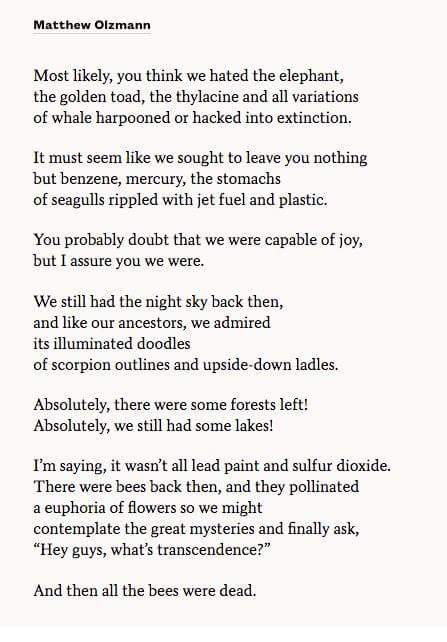
Sunday, April 23, 2017

The future we’ve been warned about

...The future we’ve been warned about is beginning to saturate the present. We tend to imagine climate change as a destroyer. But it also traffics in disruption, disarray: increasingly frequent and more powerful storms and droughts; heightened flooding; expanded ranges of pests turning forests into fuel for wildfires; stretches of inhospitable heat. So many facets of our existence — agriculture, transportation, cities and the architecture they spawned — were designed to suit specific environments. Now they are being slowly transplanted into different, more volatile ones, without ever actually moving... (continues in the NYTimes Magazine "climate issue" Apr 23, 2017)
==
The Planet Can’t Stand This Presidency, by Bill McKibben

Drumpf is in charge at a critical moment for keeping climate change in check. We may never recover.

President Drumpf’s environmental onslaught will have immediate, dangerous effects. He has vowed to reopen coal mines and moved to keep the dirtiest power plants open for many years into the future. Dirty air, the kind you get around coal-fired power plants, kills people.

It’s much the same as his policies on health care or refugees: Real people (the poorest and most vulnerable people) will be hurt in real time. That’s why the resistance has been so fierce.

But there’s an extra dimension to the environmental damage. What Mr. Drumpf is trying to do to the planet’s climate will play out over geologic time as well. In fact, it’s time itself that he’s stealing from us.

What I mean is, we have only a short window to deal with the climate crisis or else we forever lose the chance to thwart truly catastrophic heating... (continues)

Monday, March 27, 2017

The Most Efficient Way to Help the Planet


What can you — just one concerned person — do about global warming?

It may feel like a more urgent problem these days, with proposed cuts to the Environmental Protection Agency and each year warmer than the previous one.

You could drive a few miles fewer a year. Reduce your speed. Turn down your thermostat in winter. Replace your incandescent light bulbs with LEDs. Reduce your meat consumption. Any one of those actions would help.

But none would come close to doing as much as driving a fuel-efficient vehicle. If vehicles averaged 31 miles per gallon, according to our research, the United States could reduce its carbon dioxide emissions by 5 percent.

Improving fuel economy carries particular salience after the Drumpf administration announced this month that it would re-examine the progressively more stringent Obama-era fuel economy standards for vehicles in model years 2022 to 2025.


If every American household drove a vehicle getting 56 miles per gallon, it would reduce U.S. emissions by 10 percent.

The American new-vehicle fleet now averages less than half that. It is expected to average 36 m.p.g. in 2025 if Obama administration standards remain in place, according to the Environmental Protection Agency...


(nyt, continues)

Monday, March 20, 2017

The Seasons Aren't What They Used to Be


CreditJooHee Yoon

SEWANEE, Tenn. — Sexual energies were loosed early this year in Tennessee, then quashed. In February, spring peepers made my ears ring as I walked through wetlands east of Nashville’s honky-tonks. These frogs were a month ahead of their normal schedule.

But what is normal in a year when the calendar says spring starts Monday, yet the season started weeks earlier for plants and animals? When New York was clipped by a snowstorm last Tuesday, the streets had already been dusted with pollen from early-blooming red maples.

Spring has been particularly hasty and irregular this year, but this is no anomaly. In the latter half of the 20th century, the spring emergence of leaves, frogs, birds and flowers advanced in the Northern Hemisphere by 2.8 days per decade. I’m nearly 50, so springtime has moved, on average, a full two weeks since I was born. And you? We now experience climate change not only through the abstractions of science, but also through lived experience.

Early spring felt good; early spring felt dreadful. Now, whiplash as we slam into a snowbank. This is the motion sickness of climate change: The world lurches, and our bodies know that all is not well. What we experienced as spring, a predictable appearance of buds and birds, is passing away. Our children will live in uncharted, unnamed seasons.

In the forests here in Tennessee, instead of tracking foxes in winter snow, I spent February being startled by precocious bloodroot and other wildflowers piercing the leaf litter. Phoebes sallied after sun-warmed flying queen ants and spring azure butterflies. Japanese quince bloomed in garden hedges before January was over, multiflora rose broke bud on Valentine’s Day, and Mardi Gras came with Bradford pears in bloom. Then, in March: snow. A month after frogs sang through 70-degree evenings, freezes in the teens brought silence... (David George Haskell, continues)

Thursday, March 2, 2017

People’s Climate March

Bill McKibben-
I don’t know if you’re like me, but there are days when the sound of Mr. Trump’s voice just makes me want to curl up in a fetal position.

The losses we’ve suffered just in the past week, as the new EPA head started gutting water and air protections, makes me think of the earlier generations of activists who worked so hard to get these laws enacted. Tuesday night I wanted to shout at the TV when, instead of mentioning climate change, he boasted about approving new pipelines.

But then I remind myself that, given the situation, we’re off to a pretty good start fighting his efforts. The Women’s Marches and the airport protests were remarkable moments, and they put a dent in his momentum. We’ll need much more of this kind of resistance.

Specifically, for those of us focused on the climate questions that will define the future of our planet, we need to be fixing on the end of April. On April 22, Earth Day, scientists will march, and I hope the rest of us will be engaging our community: we’ve got to keep explaining to all our neighbors that climate change is the furthest thing from a hoax.

Then on April 29, which falls on about the hundredth day of the new administration, we need to gather in Washington DC and across the country for the People’s Climate March.

When we did this in New York in 2014 it helped propel the plane towards the Paris climate accords. This time we need—powerfully—to make clear that we haven’t gone away, and that we will not let the U.S. retreat.

It will be a solemn day—we’ve just come through the hottest year ever measured on this planet, after all. But it will also be a joyful and rousing one: we’ll be celebrating the launch of a new drive to make our nation run on a 100% renewable energy economy that works for all. We know Trump won’t support it, but we’re getting on with the job at hand: demonstrating the political will for climate justice so that every other politician sprints as far ahead as possible.

Here’s the place to sign up: 350.org/PCM2017. But we need you doing more than signing up and showing up. We need you, as always, organizing: getting others to come, filling buses, creating art, suggesting themes.

We need each other, really. That’s what a movement is.
Bill 

Monday, February 13, 2017

DRUMPF’S PIPELINE AND AMERICA’S SHAME

Bill McKibben:

The Drumpf Administration is breaking with tradition on so many fronts—renting out the family hotel to foreign diplomats, say, or imposing travel restrictions on the adherents of disfavored religions—that it seems noteworthy when it exhibits some continuity with American custom. And so let us focus for a moment, before the President’s next disorienting tweet, on yesterday’s news that construction of the Dakota Access Pipeline will be restarted, a development that fits in perfectly with one of this country’s oldest cultural practices, going back to the days of Plymouth Rock: repressing Native Americans.

Just to rehash the story briefly, this pipeline had originally been set to carry its freight of crude oil under the Missouri River, north of Bismarck. But the predominantly white citizens of that town objected, pointing out that a spill could foul their drinking water. So the pipeline’s parent company, Energy Transfer Partners, remapped the crossing for just north of the Standing Rock Sioux Reservation. This piece of blatant environmental racism elicited a remarkable reaction, eventually drawing representatives of more than two hundred Indian nations from around the continent to a great encampment at the confluence of the Cannonball and Missouri Rivers, near where the pipeline was set to go. They were joined, last summer and into the fall, by clergy groups, veterans groups, environmental groups—including 350.org, the climate-advocacy organization I co-founded—and private citizens, who felt that this was a chance to begin reversing four centuries of literally and figuratively dumping on Native Americans. And the protesters succeeded. Despite the German shepherds and pepper spray let loose by E.T.P.’s security guards, despite the fire hoses and rubber bullets employed by the various paramilitary police forces that assembled, they kept a nonviolent discipline that eventually persuaded the Obama Administration to agree to further study of the plan.

More remarkably, it was the U.S. Army that took the lead—the same agency that had massacred and harassed Native Americans since its founding. On December 4th, Jo-Ellen Darcy, the Army’s assistant secretary for civil works, announced that the easement required for E.T.P. to dig beneath the Missouri would not be granted. Instead, the Army Corps of Engineers would prepare an environmental-impact statement, a lengthy process that effectively put the pipeline on hold. “It’s clear that there’s more work to do,” Darcy said at the time. “The best way to complete that work responsibly and expeditiously is to explore alternate routes for the pipeline crossing.” So the Corps set about organizing public hearings and taking testimony; until Tuesday afternoon, we were in the middle of that period, with signatures coming in by the hundred thousand. But at three o’clock yesterday, acting on the President’s suggestion that the environmental review be “expedited,” the Army reverted to ancient form, shutting down the public-comment process and issuing the permits that E.T.P. needs to begin digging again. Suddenly there was not “more work to do.” Somehow, in the eighteen days since Donald Drumpf had taken office, Robert Speer, the acting secretary of the Army, had obtained “sufficient information” to grant the approval.

One feels for the Army brass. Had they continued to act responsibly and in line with their previous commitments, their careers likely would not have progressed. (Speer is apparently no Sally Yates, though those of us worried about the choleric Drumpf and his proximity to the nuclear-launch codes must hope that someone in the Pentagon is.) In any event, digging is scheduled to begin as early as this afternoon. There should, and will, be substantial protests. The first demonstrations began in major cities today, and the Standing Rock Sioux have asked Americans to descend on Washington, D.C., on March 10th. By that point, the pipeline may be all but finished, but the tribe and its attorneys at the environmental group Earthjustice have vowed to keep fighting it in the courts, even once it is carrying oil.

The bigger battle, however, may be in the tribunal of public opinion. The pipeline is a bad idea on many grounds, none of which is likely to sway Drumpf. (The fact that the oil it carries has the same carbon footprint as nearly thirty coal-fired power plants would perhaps seem a plus to him.) Tom Goldtooth, the executive director of the Indigenous Environmental Network, recently noted that Drumpf has yet to meet with any Native American leaders since taking office, which is possibly for the best, given the casual racism that might ensue. But the protests at Standing Rock have reopened the question of how the rest of America, those of us not in the White House, will treat the continent’s original inhabitants. In this standoff, we have confronted our oldest and one of our most shameful stories. That shame will deepen now—which may, once Drumpf is gone, allow us to move closer to real reconciliation. At any rate, we owe a great debt to the protesters, who have acted with a dignity conspicuously lacking in the Oval Office. New Yorker


Bill McKibben, a former New Yorker staff writer, is the founder of the grassroots climate campaign 350.org and the Schumann Distinguished Scholar in environmental studies at Middlebury College.

Wednesday, January 25, 2017

A BAD DAY FOR THE ENVIRONMENT,

WITH MANY MORE TO COME
By Bill McKibben January 24, 2017

On Tuesday, Donald Drumpf signed an executive order expediting approvals for the Keystone and Dakota Access Pipelines, overturning perhaps the two biggest environmental victories of the Obama years.PHOTOGRAPH BY DOUG MILLS / THE NEW YORK TIMES / REDUX

Tuesday began with news that the Drumpf Administration had imposed a comprehensive gag order on employees of the Environmental Protection Agency. According to a leaked memo, “no press releases,” “no blog messages,” and “no social media will be going out,” and “no new content can be placed on any website” until further notice—perhaps an attempt to camouflage the other big E.P.A. announcement, which was that the agency’s grants and contracts had been temporarily frozen, effectively halting its work. Then, at nine o’clock, the President had breakfast with a group of beaming auto executives. Drumpf told them that he was “to a large extent an environmentalist,” but apparently his long participation in that movement had persuaded him that “environmentalism is out of control.” The last time Detroit’s C.E.O.s came to the White House, in 2011, President Obama got them to agree, grudgingly, to increase average fuel economy to 54.5 miles per gallon, a pledge they now hope to recant. The day went on. Just before noon—surrounded by his increasingly familiar cast of white guys in suits—Drumpf signed an executive order expediting approvals for the Keystone and Dakota Access pipelines, thus overturning perhaps the two biggest environmental victories of the Obama years, both of which the advocacy organization I helped found, 350.org, fought for vigorously.

There is, in other words, a new day dawning, and we’re sure as hell not going to use any of that sunlight for energy. Instead, it’s clear that we’re about to witness the steady demolition, or attempted demolition, of the environmental protections that have been put in place over the past five decades. Another leaked memo, released on Monday and attributed to Myron Ebell, the veteran climate-change denier overseeing Drumpf’s E.P.A. transition team, made clear some of the Administration’s first priorities: stopping Obama’s Clean Power Plan, which uses the Clean Air Act to regulate power plants; revising the rules on development in crucial wetlands; and even such granular tasks as reining in efforts to halt the rampant pollution of Chesapeake Bay. The full list, I imagine, will stretch on and on. The nascent effort to prevent leakage from fracking wells, for instance, will likely be abandoned, meaning that we’ll continue to spew methane as well as carbon dioxide into the atmosphere. At the Department of the Interior, they’re getting ready to start leasing coal from public lands again; at State, Rex Tillerson says he wants a “seat at the table” in international climate negotiations, but probably won’t push them forward. The drive to free up polluters is so strong and ingrained that it overrides even the usual Republican commitment to states’ rights: Scott Pruitt, who sued the E.P.A. fourteen times before being named to head it, ominously said at his confirmation hearing that he couldn’t promise California would continue to receive the waiver that allows it to set its own vehicle-emissions standards.

“You say you’re going to review it?” Senator Ed Markey, of Massachusetts, asked him.

“Yes, senator,” Pruitt said.

“When you say ‘review,’ I hear ‘undo,’ ” Markey said.

There’s not the slightest evidence that Americans want laxer environmental laws. A poll released last week showed that nearly two-thirds of Americans would prefer that the E.P.A.’s powers be preserved or strengthened. Solar power, meanwhile, polls somewhere in the neighborhood of ice cream among Democrats, Independents, and Republicans alike. But the survey that counts in the Drumpf Administration is of plutocrats, and, as Jane Mayer demonstrated in her book “Dark Money,” the moguls of the right-wing funding network, whose disciples are now in place across the Cabinet, hate environmental regulation with a passion. We know some of them—the Koch brothers, for instance. But there is a whole league of cartoonish villains, including John Menard, Jr., the richest man in Wisconsin, whose company was once charged with labelling arsenic-tainted mulch as “ideal for playgrounds.” Having paid hundreds of millions in fines, these people paid tens of millions in campaign contributions, and now their bill has come due.

Against them stands reality, as a rogue employee of the National Park Servicereminded us on Tuesday afternoon, defying another gag order by tweeting out climate data from the official Badlands National Park account. The reason we have environmental regulations is because, when we didn’t, the air was filthy and the water sour. Cleaning up our skies and our streams has been an enormous success in every way, including economically: any attempt to tally things like lost work days or visits to the emergency room shows that curbing pollution has huge returns on investment. (Just ask the Chinese, who are desperately trying to cobble together their own system of environmental protections.) As in so many other cases, the returns on deregulation will go to a handful of very wealthy Americans, and the cost will be spread across society, falling particularly hard on those who live near the highways and on the flood plains. Reality gets plainer every day on a planet that just saw the hottest year ever recorded, where sea ice is at an all-time low, and where California’s epic drought has suddenly given way to epic flooding. History will judge the timing of Drumpf’s crusade with special harshness—it is, you might say, a last-gasp effort.


Bill McKibben, a former New Yorker staff writer, is the founder of the grassroots climate campaign 350.org and the Schumann Distinguished Scholar in environmental studies at Middlebury College.
More
==

Badlands

. was forced to take down their tweets about climate change, but don't worry we saved them - now let's help spread them.

Wednesday, January 11, 2017

Facts

Andy Revkin (@Revkin)
In farewell address, Obama called on Americans to center on "a common baseline of facts". Worth trying grist.org/briefly/in-his… via @grist

Obama’s faith in the eventual solubility of things is closely related to his reverence for the Enlightenment, which he name-checked while speaking of another good that Drumpf threatens to destroy: the truth. Obama posited reason as the link between challenges as diverse as climate change and international terrorism, placing it as a counterpoint to fear, which might tempt our citizenry to shake off, or take “for granted,” the freedoms guaranteed by the Constitution... (New Yorker, continues)

Tuesday, January 10, 2017

The overview effect

...It was always part of NASA’s mission to look inward, not just outward. The National Aeronautics and Space Act of 1958, which established the agency, claimed as its first objective “the expansion of human knowledge of phenomena in the atmosphere and space.” nasa’s early weather satellites were followed, in the seventies and eighties, by a slew of more advanced instruments, which supplied data on the ozone layer, crops and vegetation, and even insect infestations. They allowed scientists to recognize and measure the symptoms of climate change, and their decades’ worth of data helped the Intergovernmental Panel on Climate Change conclude, in 2007, that global warming is “very likely” anthropogenic. According to a report released last month by nasa’s inspector general, the agency’s Earth Science Division helps commercial, government, and military organizations around the world locate areas at risk for storm-related flooding, predict malaria outbreaks, develop wildfire models, assess air quality, identify remote volcanoes whose toxic emissions contribute to acid rain, and determine the precise length of a day.

These seem like key functions of civilization as we know it...

...We seem to need to see the planet as a whole in order to think about it as such.

Generations of astronauts, after looking at Earth from space, have professed a profound new understanding of it. Edgar Mitchell, who, in 1971, became the sixth man to walk on the moon, said, “From out there . . . international politics look so petty. You want to grab a politician by the scruff of the neck and drag him a quarter of a million miles out and say, ‘Look at that, you son of a bitch.’ ” Michael Collins, Neil Armstrong’s crewmate on Apollo 11, expressed similar sentiments in his memoir, “Carrying the Fire,” which was published in the midst of the Cold War. Seeing our home planet from afar, he wrote, prompted an epiphany: “The earth must become as it appears: blue and white, not capitalist or Communist; blue and white, not rich or poor; blue and white, not envious or envied.”

Mike Massimino, in his memoir, “Spaceman,” reports having spent almost a full day staring out a window of the Space Shuttle Columbia, watching sunrises and lightning storms (“like a form of communication, like a sequence, like the clouds are alien creatures speaking to each other in code”). On his second spacewalk, Massimino told me recently, he had a spare moment to “take in the view.” He recalls being struck not only by Earth’s incredible beauty—“We are living in a paradise”—but also by its fragility. From out there, he said, especially during night passes, “you can see the thinness of the atmosphere,” a bluish-green line. This sudden perception of Earth as a delicate, intricate system is so common among astronauts that the writer Frank White coined a term for it: the overview effect...

"NASA’S OVERLOOKED DUTY TO LOOK INWARD" continues

Wednesday, January 4, 2017

Thawed skepticism

Half a decade before he took this trip to the farthest reaches of the north, Andreas Muenchow had his doubts about whether warming temperatures were causing one of the world’s great platforms of ice to melt and fall apart.

He even stood before Congress in 2010 and balked on whether climate change might have caused a mammoth chunk of ice, four times the size of Manhattan, to break off from this floating, 300-square-mile shelf. The University of Delaware oceanographer said he wasn’t sure. He needed more evidence.

But then the Petermann Ice Shelf lost another two Manhattans of ice in 2012, and Muenchow decided to see for himself, launching a project to study the ice shelf intensively.

He was back again in late August, no longer a skeptic. It was hard not to be a believer here at 81 degrees north latitude, where Greenland and Canada very nearly touch. The surface of the bumpy and misshapen ice was covered with pools and puddles, in some cases frozen over but with piercing blue water beneath. Streams carved through the vast shelf, swelling into larger ponds or even small lakes.

The meltwater was a sign the ice shelf was growing more fragile, moving closer to the day when it might give up more city-size chunks of ice.

The Petermann Ice Shelf serves as a plug of sorts to one of Greenland’s largest glaciers, lodged in a fjord that, from the height of its mountain walls down to the lowest point of the seafloor, is deeper than the Grand Canyon. There’s enough ice piled up behind Petermann to raise oceans globally by nearly a foot someday.

The question for Muenchow is no longer whether Petermann is changing — it’s how fast it could give up still more ice to the seas. That’s why he and British Antarctic Survey colleague Keith Nicholls ventured here by helicopter to take the measure of the Petermann shelf, which had been shifting and surging in a way that damaged the scientific instruments they had left behind a year earlier — behaving as though it didn’t want to be known...

Tuesday, January 3, 2017

Who cares about climate change?


Here’s a question you probably shouldn’t ask yourself unless you’re prepared for an unsettling answer: which problems facing the modern world do you really, truly care about the most, as measured by how emotionally exercised you get, and how willing you are to take action? Somewhere near the top, for me, is the man who illegally parks his dark blue van outside my apartment building almost every week; he reliably renders me furious, and I never fail to make an online complaint. A little lower down the list comes the recent decision by my fellow Brits to leave the European Union; and below that, terrorist atrocities: appalling as they are, they’re so incomprehensible that my main response is bafflement. Below all these comes climate change. Apart from brief flashes of raw sadness at what’s happening to the planet, and my complicity in it, the shameful reality is that it generally just isn’t a regular cause of motivating emotion.

This probably makes me a bad person, but I’m not a stupid one: I can see that my priorities, judged by the vehemence of my emotions, are precisely upside-down. Like many other people, I’m a walking embodiment of Sayre’s Law, coined by the American political scientist Wallace Sayre: when it comes to political disputes (and, he might have added, other societal challenges) intensity of feeling is inversely proportional to what’s at stake. We tend to care most about what matters least, and vice versa – a very human flaw, perhaps, but one that may yet bring about our destruction. The problem of humanity’s impact on our natural habitat feels too complex to understand; too big for any individual to make a difference; and potentially so catastrophic as to be painful to contemplate. No wonder it’s more appealing to pursue my vendetta against Blue Van Guy instead.

This predilection for focusing our energies on precisely the wrong things is nothing new: in his famous letter On the Shortness of Life, the Stoic philosopher Seneca bemoaned his fellow Romans’ tendency to fill their lives with pointless busywork, rather than using their short span of time more meaningfully. (Which meant, Seneca argued, using it to do philosophy.) What’s different about climate change, psychologically speaking, is the way it triggers an unprecedented combination of our in-built self-sabotaging impulses. As recent research in behavioural economics has shown, we’re largely unable to make small sacrifices now to avert major losses later on – and we’re much more troubled by threats we can mentally picture (a terrorist planting a bomb, a thief with a gun) than those that are harder to visualise (the systemic ramifications of a one-degree rise in global temperatures, say). Besides, when we do take some selfless action, such as donating to an environmental charity, we become immediately prone to ‘moral licensing’, the phenomenon whereby the warm inner glow of having done the right thing provides an excuse for doing something that cancels out the benefits, such as eating more meat, or turning up the air conditioning. Some of these cognitive biases have evolutionary justifications: in early human communities, for example, easy-to-picture dangers probably did pose the greatest threat. Now, though, they’ve become a serious impediment to our safety – one that Daniel Kahneman, the doyen of cognitive bias researchers, has said he’s personally pessimistic we’ll ever manage to surmount.

Yet perhaps the most interesting and troubling psychological feature of climate change, ironically enough, is how boring it is to so many of us. The filmmaker Randy Olson has called this “the great unmentionable” of the environmental movement, and at first glance it makes little sense: such a severe, planet-wide threat might well terrify us into paralysis, but you’d hardly expect it to seem dull. The truth, though, is that modernity’s most pressing problems are frequently among the least interesting – in part because they involve not exciting individual human dramas, which seize our attention and evoke empathy, but complex interconnected systems and endless quantities of data. The global financial meltdown of 2007-8 was of little interest to anyone other than specialists, or those worst affected, until it began to involve TV images of homeowners forced from their dwellings, or fired bankers carrying out boxes of their belongings on to Wall Street.

There are, of course, dramatic human stories unfolding right now as a consequence of the climate crisis – but they tend either to be happening far away, or difficult to attribute definitively to global warming. (Those displaced by flooding and fires in the US, for example, rarely get described as climate refugees.) The conspiratorial thinking of climate denial, by contrast, positively teems with gripping tales of evil scientists scheming in backrooms. These stories may be false – but you can’t claim they’re not compelling. They are testaments to what the literary scholar Jonathan Gottschall, author of The Storytelling Animal, has called “the vast, witchy power of story in human life”. Stories compel us, whether or not they’re true; facts may not, even though they are.

Or maybe the feeling of boredom is better explained psychoanalytically, as a defence against emotions we daren’t make conscious – a numbing but easier alternative to confronting the horror we’re helping to perpetrate? Either way, it’s natural enough for climate campaigners to want to shock people out of their listlessness with graphic imagery and dire warnings. But as a widely reported study showed in 2011 – and subsequent research has confirmed – such messages can easily backfire. The more alarming they are, the more likely audiences are to discount them because of the challenge they pose to the ‘just world bias’, the widely held, if usually unarticulated, assumption that life is generally safe, predictable, and fair. When confronted with evidence that contradicts a deeply-held belief, we’re frighteningly skilled at dismissing the evidence, rather than changing the belief. And even if they don’t backfire, they risk working too well, inducing a sense of helplessness. That despair can then serve as a defence mechanism: if there’s no point in caring about the climate, nor can there be any ethical obligation to do so.

It would be absurd to propose any simple remedy for this predicament. (Who said the existence of a problem entails the existence of a solution anyway?) Personally, though, I’ve found both solace and motivation in the work of Derrick Jensen, a co-founder of the environmental movement Deep Green Resistance. Jensen keeps fighting in the face of despair, he has written, because he’s “in love. With salmon, with trees outside my window, with baby lampreys living in sandy streambottoms… and if you love, you act to defend your beloved. Of course results matter to you, but they don’t determine whether or not you make the effort.” Though it risks sounding sentimental, thinking in terms of love is actually highly clarifying. Instinctively, we understand what it entails: most of us would condemn a parent who stopped caring for a child simply because the experience was often tedious, or inconvenient, or scary, or because success couldn’t be guaranteed. If we claim to love the planet, why should things be any different? “If my love doesn’t cause me to protect what I love,” as Jensen puts it, “it’s not love.”

The climate crisis may sometimes bore me, or strike me as hopeless, or fail to make me as viscerally angry as it should (or as Blue Van Guy does). But so what? Virtually everyone already knows the experience of investing time and energy in caring for those you love, regardless of whether, in that very moment, you happen to feel like it. You don’t usually do it for some future payoff, or even for the warm inner glow. On the contrary, it’s self-justifying. You do it because it’s what needs to be done.

Monday, December 26, 2016

"Cancer and climate change"

I’M a climate scientist who has just been told I have Stage 4 pancreatic cancer.

This diagnosis puts me in an interesting position. I’ve spent much of my professional life thinking about the science of climate change, which is best viewed through a multidecadal lens. At some level I was sure that, even at my present age of 60, I would live to see the most critical part of the problem, and its possible solutions, play out in my lifetime. Now that my personal horizon has been steeply foreshortened, I was forced to decide how to spend my remaining time. Was continuing to think about climate change worth the bother?

After handling the immediate business associated with the medical news — informing family, friends, work; tidying up some finances; putting out stacks of unread New York Times Book Reviews to recycle; and throwing a large “Limited Edition” holiday party, complete with butlers, I had some time to sit at my kitchen table and draw up the bucket list.

Very quickly, I found out that I had no desire to jostle with wealthy tourists on Mount Everest, or fight for some yardage on a beautiful and exclusive beach, or all those other things one toys with on a boring January afternoon. Instead, I concluded that all I really wanted to do was spend more time with the people I know and love, and get back to my office as quickly as possible.

I work for NASA, managing a large group of expert scientists doing research on the whole Earth system (I should mention that the views in this article are my own, not NASA’s). This involves studies of climate and weather using space-based observations and powerful computer models. These models describe how the planet works, and what can happen as we pump carbon dioxide into the atmosphere. The work is complex, exacting, highly relevant and fascinating.Continue reading the main story

Last year was the warmest year on record, by far. I think that future generations will look back on 2015 as an important but not decisive year in the struggle to align politics and policy with science. This is an incredibly hard thing to do. On the science side, there has been a steady accumulation of evidence over the last 15 years that climate change is real and that its trajectory could lead us to a very uncomfortable, if not dangerous, place. On the policy side, the just-concluded climate conference in Paris set a goal of holding the increase in the global average temperature to 2 degrees Celsius, or 3.6 degrees Fahrenheit, above preindustrial levels.

While many have mocked this accord as being toothless and unenforceable, it is noteworthy that the policy makers settled on a number that is based on the best science available and is within the predictive capability of our computer models.

It’s doubtful that we’ll hold the line at 2 degrees Celsius, but we need to give it our best shot. With scenarios that exceed that target, we are talking about enormous changes in global precipitation and temperature patterns, huge impacts on water and food security, and significant sea level rise. As the predicted temperature rises, model uncertainty grows, increasing the likelihood of unforeseen, disastrous events.

All this as the world’s population is expected to crest at around 9.5 billion by 2050 from the current seven billion. Pope Francis and a think tank of retired military officers have drawn roughly the same conclusion from computer model predictions: The worst impacts will be felt by the world’s poorest, who are already under immense stress and have meager resources to help them adapt to the changes. They will see themselves as innocent victims of the developed world’s excesses. Looking back, the causes of the 1789 French Revolution are not a mystery to historians; looking forward, the pressure cooker for increased radicalism, of all flavors, and conflict could get hotter along with the global temperature.

Last year may also be seen in hindsight as the year of the Death of Denial. Globally speaking, most policy makers now trust the scientific evidence and predictions, even as they grapple with ways to respond to the problem. And most Americans — 70 percent, according to a recent Monmouth University poll — believe that the climate is changing. So perhaps now we can move on to the really hard part of this whole business.

The initial heavy lifting will have to be done by policy makers. I feel for them. It’s hard to take a tough stand on an important but long-term issue in the face of so many near-term problems, amid worries that reducing emissions will weaken our global economic position and fears that other countries may cheat on their emissions targets.

Where science can help is to keep track of changes in the Earth system — this is a research and monitoring job, led by NASA and the National Oceanic and Atmospheric Administration and their counterparts elsewhere in the world — and use our increasingly powerful computer models to explore possible futures associated with proposed policies. The models will help us decide which approaches are practicable, trading off near-term impacts to the economy against longer-term impacts to the climate.

Ultimately, though, it will be up to the engineers and industrialists of the world to save us. They must come up with the new technologies and the means of implementing them. The technical and organizational challenges of solving the problems of clean energy generation, storage and distribution are enormous, and they must be solved within a few decades with minimum disruption to the global economy. This will likely entail a major switch to nuclear, solar and other renewable power, with an electrification of our transport system to the maximum extent possible. These engineers and industrialists are fully up to the job, given the right incentives and investments. You have only to look at what they achieved during World War II: American technology and production catapulted over what would have taken decades to do under ordinary conditions and presented us with a world in 1945 that was completely different from the late 1930s.

What should the rest of us do? Two things come to mind. First, we should brace for change. It is inevitable. It will appear in changes to the climate and to the way we generate and use energy. Second, we should be prepared to absorb these with appropriate sang-froid. Some will be difficult to deal with, like rising seas, but many others could be positive. New technologies have a way of bettering our lives in ways we cannot anticipate. There is no convincing, demonstrated reason to believe that our evolving future will be worse than our present, assuming careful management of the challenges and risks. History is replete with examples of us humans getting out of tight spots. The winners tended to be realistic, pragmatic and flexible; the losers were often in denial of the threat.As for me, I’ve no complaints. I’m very grateful for the experiences I’ve had on this planet. As an astronaut I spacewalked 220 miles above the Earth. Floating alongside the International Space Station, I watched hurricanes cartwheel across oceans, the Amazon snake its way to the sea through a brilliant green carpet of forest, and gigantic nighttime thunderstorms flash and flare for hundreds of miles along the Equator. From this God’s-eye-view, I saw how fragile and infinitely precious the Earth is. I’m hopeful for its future.

And so, I’m going to work tomorrow.

nyt

Piers J. Sellers is the deputy director of Sciences and Exploration at the NASA Goddard Space Flight Center and acting director of its Earth Sciences Division. As an astronaut, he visited the International Space Station three times and walked in space six times

The Conversation US (@ConversationUS)
If a corporation can have the rights of a person, why can't the natural world have rights? #reversecitizensunited bit.ly/2hQUr5z

Wednesday, December 21, 2016

"These six utopian cities of the future will help you re-imagine life on Earth"


Utopia, a book by English statesman, lawyer and clergyman Thomas More (1487-1535), turns 500 years old this month. A fictional rendering of social philosophy, the book describes an exemplary society on an imaginary island in an unknown place faraway across the seas. Coined by More from the Greek ou-topos, meaning no place, or nowhere, the word utopia has become adopted in the English language to mean a place where everything is ideal or perfect. In celebrating Utopia’s 500th birthday, the Ecotopia 2121 project, of which I am the coordinator, is harnessing Thomas More’s spirit to predict the futures of 100 real cities around the world - if they somehow managed to become super eco-friendly. Of course, modern utopias need to be eco-friendly to overcome the global environmental crisis. Given that cities may be home to 80% of humanity by the end of the century, they can only be sustainable if environmentalism is one of their core features.


The cities of Ecotopia 2121 are presented in the form of “scenario art”, which involves a review of both global and local environmental challenges as well as their unique histories and cultures. This allows for a diversity of future scenarios rather than one common vision of the “future city”. What you will see below are a series of artworks, but this is not an art project. We use art as a means of analysis and communication. With that in mind, here are six ecotopian cities of my own creation that emerged from the project, one from each inhabited continent.

Accra 2121

Accra, the capital of Ghana, is exposed to disastrous floods every year. This has been made worse by climate change, as well as unregulated construction and dumping in and around its waterways. In our imagined future, locals seek to procure housing above the floodline, by building low-cost tree cabins in the nearby forest.


Ghana has one of the highest deforestation rates in the world, but by 2121, the forest has become a home for some of its citizens. Accra’s new residents would protect the forest ecosystem from those who would destroy it, such as the logging, mining and oil companies.

London 2121

In the summer of 2121, during an economic downturn, 100,000 pensioners take to the streets of London, the British capital, to protest cuts in pensions and education, shutting down the entire city. They bring along their grandchildren to give them something interesting to do as they mind them. By summer’s end, the protesters despair at the government’s poor response, so they take matters into their own hands, staging a permanent occupation.


The pensioners convert some 20km² of London into a large eco-village, transforming unoccupied offices into homes, sowing garden lots on street corners, and setting up eco-businesses to trade products and services. In the process, all the children get free education from their experienced elders in these various green arts and crafts.

Los Angeles 2121

The southern Californian city of Los Angeles once had a great network of tramways, but this was systematically bought up and then closed down by a group of conspiring auto-manufacturing companies.


As the world’s oil is depleted by the end of this century, cars will become useless and trams could make a comeback in Los Angeles. The unused freeways could then be redeveloped into vegetated greenways. Such greenways are suited for pedestrians and cyclists, but they could also act as ecological corridors, connecting populations of wild plants and animals around the city that would otherwise be isolated. Retired cars could then serve as part of the fabric of high-density buildings, creating an architectural style whereby people live and work in smaller structures and within tighter-knit communities. This would mean cities such as Los Angeles would not need to sprawl further into the countryside and wild lands.

Alan Marshall, Mahidol University - continues

Sunday, December 18, 2016

A Way Forward

Phil -  don't know if you've seen this article in The New Yorker.  I've also read the 23 page document the authors created.  It seems to me an excellent way to move a progressive agenda forward - or any agenda for that matter - given the current character of the US House and Senate:
http://www.newyorker.com/news/news-desk/the-crowd-sourced-guide-to-fighting-trumps-agenda?mbid=nl_121716_Daily_Amanda&CNDID=11280738&spMailingID=10072715&spUserID=MTMzMTc5NTUyMTg4S0&spJobID=1061545985&spReportId=MTA2MTU0NTk4NQS2

There's hope abroad in the land!

Thursday, December 15, 2016

Exxon's climate lie: 'No corporation has ever done anything this big or bad'

I

’m well aware that with Paris looming it’s time to be hopeful, and I’m willing to try. Even amid the record heat and flooding of the present, there are good signs for the future in the rising climate movement and the falling cost of solar.

But before we get to past and present there’s some past to be reckoned with, and before we get to hope there’s some deep, blood-red anger.

In the last three weeks, two separate teams of journalists — the Pulitzer-prize winning reporters at the website Inside Climate News and another crew composed of Los Angeles Times veterans and up-and-comers at the Columbia Journalism School — have begun publishing the results of a pair of independent investigations into ExxonMobil.

Though they draw on completely different archives, leaked documents, and interviews with ex-employees, they reach the same damning conclusion: Exxon knew all that there was to know about climate change decades ago, and instead of alerting the rest of us denied the science and obstructed the politics of global warming.

To be specific:
  • By 1978 Exxon’s senior scientists were telling top management that climate change was real, caused by man, and would raise global temperatures by 2-3C this century, which was pretty much spot-on.
  • By the early 1980s they’d validated these findings with shipborne measurements of CO2 (they outfitted a giant tanker with carbon sensors for a research voyage) and with computer models that showed precisely what was coming. As the head of one key lab at Exxon Research wrote to his superiors, there was “unanimous agreement in the scientific community that a temperature increase of this magnitude would bring about significant changes in the earth’s climate, including rainfall distribution and alterations in the biosphere”.
  • And by the early 1990s their researchers studying the possibility for new exploration in the Arctic were well aware that human-induced climate change was melting the poles. Indeed, they used that knowledge to plan their strategy, reporting that soon the Beaufort Sea would be ice-free as much as five months a year instead of the historic two. Greenhouse gases are rising “due to the burning of fossil fuels,” a key Exxon researcher told an audience of engineers at a conference in 1991. “Nobody disputes this fact.”

But of course Exxon did dispute that fact. Not inside the company, where they used their knowledge to buy oil leases in the areas they knew would melt, but outside, where they used their political and financial might to make sure no one took climate change seriously.

They helped organise campaigns designed to instil doubt, borrowing tactics and personnel from the tobacco industry’s similar fight. They funded “institutes” devoted to outright climate denial. And at the highest levels they did all they could to spread their lies.

To understand the treachery – the sheer, profound, and I think unparalleled evil – of Exxon, one must remember the timing. Global warming became a public topic in 1988, thanks to Nasa scientist James Hansen – it’s taken a quarter-century and counting for the world to take effective action. If at any point in that journey Exxon – largest oil company on Earth, most profitable enterprise in human history – had said: “Our own research shows that these scientists are right and that we are in a dangerous place,” the faux debate would effectively have ended. That’s all it would have taken; stripped of the cover provided by doubt, humanity would have gotten to work.

Instead, knowingly, they helped organise the most consequential lie in human history, and kept that lie going past the point where we can protect the poles, prevent the acidification of the oceans, or slow sea level rise enough to save the most vulnerable regions and cultures. Businesses misbehave all the time, but VW is the flea to Exxon’s elephant. No corporation has ever done anything this big and this bad.

I’m aware that anger at this point does little good. I’m aware that all clever people will say “of course they did” or “we all use fossil fuels”, as if either claim is meaningful. I’m aware that nothing much will happen to Exxon – I doubt they’ll be tried in court, or their executives sent to jail.

But nonetheless it seems crucial simply to say, for the record, the truth: this company had the singular capacity to change the course of world history for the better and instead it changed that course for the infinitely worse. In its greed Exxon helped — more than any other institution — to kill our planet.
Bill McKibben, The Guardian Oct.14, 2015

Wednesday, December 14, 2016

"The threat is us, the solution is in us"

Review of THE UNNATURAL WORLD: The Race to Remake Civilization in Earth’s Newest Age
By David Biello

The term Anthropocene is geological shorthand for a world of carbon-induced climate havoc — i.e., the world in which we now live, a world where, given the frightening pace of global warming, all bets are off. (By last summer, the hottest on record, mass coral bleaching was racing through the world’s oceans, with more than 90 percent of the Great Barrier Reef already bleached.) In “The Unnatural World: The Race to Remake Civilization in Earth’s Newest Age,” David Biello, the science editor for TED and a contributing editor at Scientific American, sets off on a tour of our Anthropocenic world, to scout for ideas on how we might now live on a planet that our grandparents won’t recognize for long. Early on, Biello visits with a paleobiologist at the University of Leicester, who tells him, bluntly, “We’ve reset the Earth’s biology.” For some people, “that is the argument of the Anthropocene — a warning that our bad ways will quickly lead to our extinction,” Biello writes. “But for others, it’s a challenge. How do we make a good human epoch?”

“The Unnatural World” is a travelogue with that good human epoch in mind, a trip around the world to meet people working out new ways for humanity to live as well as survive. At the University of Leicester, the paleobiologist describes the man-made fossils that mark human presence — the stratum of plastics, soot and radionuclides that stain the Earth everywhere from lake bottoms to mountaintops. “Massive technofossils like London and Shanghai will call out to the future: Something was here!” Biello writes.

Indeed, the defining feature of the new world is a tangle of what we consider natural and what we don’t, nature not ended but morphed. In Maryland, Biello visits a landscape ecologist who has pioneered investigations of human interactions with ecosystems, mapping various anthropogenic biomes, concluding that people are, in Biello’s words, “the world’s most (successful) invasive species.” Biello follows along as this ecologist programs drones to monitor forests in the anthropogenic biome known as suburban Maryland, refining ways to measure and manage relatively new landscapes. “The threat is us, the solution is in us,” Biello writes... 

(Robert Sullivan, continues)

Tuesday, December 13, 2016

Friday, December 9, 2016

Before the Flood PT 2. *Sorry for lateness. Wanted to share for educational purposes even if too late. Link to film included


So, for my second installment about Before the Flood, I’m going to talk about how the movie show us the moral responsibility we hold as humans to make active movements toward supporting the environment, why we’re facing such opposition on the issue (although I know everyone in this class already knows why), and a little hope for the future.
Before the Flood highlighted some devastating results of climate that I had not thought about it and it just made me think: Don’t I have a moral responsibility to these effects? If I know there are fellow humans out there suffering, even if I am separated by land, and I also know there is some action I can take to prevent their suffering, then I morally responsible for doing so. For example, China manufactures for the entire world. They make A LOT of products that we use in our everyday lives. I know we’ve all seen “Made in China” tags on things. I’ve seen those tags more than I’ve seen “Made in USA”. That being said, China is also the largest contributor to CO2 in the entire world. But it’s because they are making things for other countries, like ours. The movie showed people living in China that have to wear masks to go outside. They have to protect themselves just to go out into the world. Some people were describing their fear of getting cancer just from breathing in the air around them. Can you imagine putting a mask on your child to go play soccer outside? It’s devastating. Not to mention the psychological understanding that these kids have to have. They were born into a world where the air they breathe is not suitable for them to live without protection. And some know the reason they have to wear masks is because an old man wants to keep profiting billions from oil and coal. I feel guilty when I hear facts like this, I feel like I’m living in an illusion and when I am told about children in China wearing masks to school, illusion is shattered. Another shattering fact I learned from the movie is that there are millions of people without simple electricity. Right now, I sit with Wi-Fi, my phone is charging, I have a lamp on, my Christmas lights are strung up around my apartment, glittering with electricity. My feet are receiving cozy warm air from a heater. There are humans, on this planet, at this time, that does not have access to ANY electricity. Mind blowing. For some reason, I tend to unconsciously think that everyone has the privileges that I do. Until I am reminded that I am so so wrong. There were some interesting statistics provided. Every human in the USA using electricity is equivalent to 64 humans in India. 64 humans use the same amount of electricity as ME. But if we had renewable energy technology, there is no need to connect to a grid. A tribe in Africa can have their own power without needing cables that connect to some more-fortunate city. Once we make the transfer to renewable, everyone can enjoy free energy FOREVER. It’s a textbook perfect solution. The perfect answer: Free energy from the sun! Forever! So why haven’t we switched yet?! Well, the movie makes a few valid points on why renewable energy is facing such opposition. Sadly, the main reason is greedy, selfish mindsets. Money-hungry humans. The fossil fuel industries organize fear. They buy out the senate so that no environmental bills can be passed (A name I recognized was Paul Ryan, but they list a hefty list). Then the people who have sold their morals for a check speak out against climate change with false statistics and facts. As Dr. Michael Mann said in the movie, “They do not need to win scientific debate, they just need to divide the public.” THIS IS THE TRUTH. Dividing the public is key for these monsters. I feel the same can be said with the police brutality stories. There are definitely other factors going on, but who do you think benefits from dividing the public vs. the police? Not us, that’s for sure. Anyway, James Inhoffe is a chair on the Senate Environmental Committee, and he is the largest fossil fuel recipient in the senate. Suprising, right? These men are simply bought out. What we need is a society with a little more backbone, hopefully our generation can change that. Our two biggest oppositions are money and ignorance. People simply do not KNOW enough about this issue. The information is out there, sure, but I think once the public is informed of the truth, even money can’t overcome that. Leonardo says, "The truth is, the more I learn about this issue, and everything that contributes to the problem, the more I realize how much I don't know about this issue." I think that's how the public generally feels. We've all heard the terms and we know that it's oil and electricity and so on. What we know is the tip of the iceberg. That's all I knew before taking this class. Now I feel much much worse about the issue, but at least I know the truth. When the public knows the truth, about our dying populations of wildlife, about our rainforests turning to dust, that children in China wear masks to play outside, that our species WILL be gone in a few hundred years if we don't drastically change our ways is when things will change. As President Barack Obama said in the documentary, "Reality has a way of slapping you in the nose when you're not paying attention. The public is starting to get with the science, in part because it's indisputable." Dr. Michael E Mann said in the film, “You give people the data, you empower the people.” People need to be educated, and informed, fast. Then we can unite and work together, that’s when we will see progress. Those fossil fuel dinosaurs can be beat, it’s just going to take persistence and force. I have hope for us. I think everyone should. If we lose hope, we’ve already lost.

** IT IS SO WORTH YOUR TIME TO SEE THE FILM. I cried. Twice. It recharges you while also reminding you that we are in dire circumstances.  Here is a link to the entire film.
https://www.youtube.com/watch?v=8v1kU7Rc9c4

A Look at Change - How and Why? Part 2

                I’ll start with just a quick review of what I said in part 1 in case you don’t want to read the first thousand words (I wouldn’t blame you).
I’m making the assumption that humans need to experience some great amount of change to stop and/or reverse the damage we’ve done to the world. My first post attempted to examine how that change might happen. By splitting “change” up into two large halves (reactive and proactive). I defined “reactive” as a population dealing with some sort of phenomena they’ve been exposed to; I defined “proactive” as a type of change resulting from some sort of intentional advancement. While the categories don’t inherently imply that their change is good/bad, it’s really easy to see how examples of reactive events tend to be bad and examples of proactive events tend to be good. My examples will reflect that, but I don’t want them to necessarily enforce the idea.
As my first example of a reactive event, I looked at the 9/11 attacks on America because it is the best example that my generation of Americans have so far. This event illustrated perfectly my theme here- that some sort of huge event (terrorist attack costing thousands of lives and billions of dollars) is going to be required for us to make any sort of positive change (in the same way airlines and general security changed after 9/11).

               
     My second example of a reactive event is the atomic bombing of Hiroshima and Nagasaki. I’m going to pull a block quote from the Wiki page because it’s more precise and brief than I could be:

“The United States, with the consent of the United Kingdom as laid down in the Quebec Agreement, dropped nuclear weapons on the Japanese cities of Hiroshima and Nagasaki on August 6 and 9, 1945, respectively, during the final stage of World War II. The two bombings, which killed at least 129,000 people, remain the only use of nuclear weapons for warfare in history.”  
                So, it’s impossible to argue that massive change did not occur as a result of this event. Before I talk about big picture stuff, I’ll talk about the immediate effect on the people who lived in Hiroshima and Nagasaki. First, there was obviously an immense loss of life, made even worse (by some definitions) by the fact that they were civilian lives. Ninety percent of structures in the two cities were reduced to rubble, and those who survived the initial blast and were not incapacitated or otherwise maimed were left to walk the scorched ruins and rebuild. There was a massive amount of area that had to be surveyed and quarantined, and an even greater need than that was to survive. The affected people had to attempt to grow food in their own gardens or barter with farmers in more rural areas with little more than the rubble the bomb had left them. For these people, change was survival, and in that, a necessity.
                I believe the world experiences hardship and grows from it just as people do, and this may be the best example of that sentiment. War has and will never be the same after the unprecedented destruction following the detonation of the atomic bombs. The immense suffering and loss of life brought about by this event is terrible and tragic, and the minds that allowed it are equally as disturbing in my mind. By August 6, 1945, we had already tested plenty of huge bombs on tiny pacific islands, so we knew full well what to expect when we dropped it on a dense population center, so I won’t hear any defense claiming ignorance. We knew approximately how many people were living in the cities, how much force it takes to knock down their buildings, and the second, third, and fourth order effects. It’s sad to think that a group of people collectively agreed that causing devastation on that scale to a civilian population was in any way at all the correct choice, but it happened, and the world has definitely lived with its choices.
                There are a few bits of this we can salvage and relate to our possible future with climate change. First, very many people were killed in the atomic bombings, but some people still survived, and they rebuilt over time. There is a negative way to view this- if people survived and rebuilt after that tragedy, what’s to stop us from being complacent, losing hundreds of thousands of lives by way of climate change, and simply rebuilding afterwards? However, I prefer the positive outlook, and that is: those people were able to survive and make progress despite their awful circumstances.
                The world certainly learned a valuable lesson from the bombings. There have been meetings and treaties galore following the chaos of World War II in hopes that none of the atrocities will happen again.
                __________
                There are some really great examples of proactive movements creating a huge change in the way people go about their lives. One of my favorite examples is the invention and proliferation of the printing press and printed material in the late 15th century.
“The printing press was invented in the Holy Roman Empire by the German Johannes Gutenberg around 1440, based on existing screw presses. Gutenberg, a goldsmith by profession, developed a complete printing system, which perfected the printing process through all of its stages by adapting existing technologies to the printing purposes, as well as making groundbreaking inventions of his own. His newly devised hand mould made for the first time possible the precise and rapid creation of metal movable type in large quantities, a key element in the profitability of the whole printing enterprise.”
                The introduction of the printing press and printed material completely changed society- initially in Western Europe, then eventually throughout the entire world. Everyday citizens suddenly had access to information and concepts that simply weren’t readily available to them. The sheer quantity of information that could be produced with a press as opposed to handwriting changed society in that it was much harder to control public opinion.
                Besides creating an entirely new industry, Gutenberg provided Western civilization with an enormously useful tool, and gave a wake-up call to all of those in power who used misinformation (or simply a lack of information at all) as a method of controlling their population.
                It’s not hard to relate this argument to the unfathomable amount of information available to anyone with a smartphone. Especially with this recent election (which I promised myself not to talk about), misinformation is an incredibly serious problem. Perhaps it’s not necessarily the access to information that’s the problem, but so many peoples’ inability to sort through it and find truth. An easy answer to that is increasing quality/availability of education. Somebody said “a democracy is only as good as its educational system” and I don’t find many people defending the public education of the U.S., and I see many reasons to fear for the integrity and strength of our democracy.
                The last example I’ll cover is something a bit broader but still relatable: the invention of the plow and the agricultural revolution. Before the invention of the plow, society was composed of mostly hunters and gatherers. The plow allowed for crops to be planted and harvested on a scale previously unattainable. People suddenly were able to produce way more food than they needed to survive, and they could trade their excess for goods and services. The agricultural revolution is sort of the pretext to how human society is structured today, which means it was a change on an absolutely massive scale.
                It’s a little less straightforward to equivocate the type of total change the agricultural revolution brought about to how we could deal with climate change in the future. I like to view it in a similar way I view the printing press- a single invention caused a great number of people to lead more comfortable lives (I’m aware of the theories that glorify hunter/gatherer societies). People were able to stay more or less in the same areas, build up and expand with their excess, and make great things for humanity that may have otherwise been impossible. The way that we are living and conducting ourselves today by expanding at great cost to the Earth is wrong and a revolution the likes of agricultural revolution may be difficult to imagine in the modern world, but a revolution with the future health of the planet at the forefront is something that we could certainly use.
                Thanks for sticking with this to the end. I wish there was a continuation of this course so I could apply this concept of change on a large scale to speculate at how exactly we might change for the better. After all the things I’ve learned this semester that have given me no reason to hope for improvement, I remain cautiously optimistic that some great event (hopefully positive) will push us in the right direction.

Word count: 1508
Total word count: 2463