Monday, October 10, 2016

Oct 13 Intro and Ch 1&2: Atmosphere of Hope


Don Enss

Intro and Chapter 1&2:

1.      According to Flannery, what are the best signs yet that we might keep ourselves safe?

2.      What accord today is the basis of global climate action?

3.      What is the “third way” concept that Flannery proposes?

4.      The link between what? and what? is a critical area for public understanding and why?

5.      In 2014, the suspension of what event in Australia made global news?

6.      What has been the effect of global warming on the ragweed season in North America?

7.      According to a recent Australian report, whose health is most at risk?

8.      What is the one area where the global climate has improved somewhat and what is the potential long-term risk of this change?


9.      What could we see in the Arctic between 2040 and 2050 for the first time in over a million years?

Friday, October 7, 2016

Quiz Oct 13

Atmosphere of Hope

1.  What gathering last December does Tim Flannery say might create an atmosphere of hope?

2. Digital connectedness has brought what new opportunities?

3. What may the "third way" allow us to do in coming decades?

4. What excellent website on climate science does Flannery recommend?

5. What "silent killer" accounted for so many "excess deaths" in Melbourne?

6. What other silent killer takes more than 300,000 lives every year?

7. Why are extreme warming-induced snowfalls a problem?

8. How long might "mega droughts" last, later in this century?

9. What did NASA conclude about six big glaciers that drain into Amundsen Bay?

DQ

  • Is it reasonable to place our hope in nonbinding international accords?
  • Have most people now experienced enough extreme weather to know that climate change is real? xii
  • Do you think the public understands the health implications of a warming world? Why hasn't climate change been framed as a public health issue?
  • Do you think people who don't live near coasts tend to be dismissive of sea level rise? What would you tell such people?

Bill McKibben (@billmckibben)
The great @ElizKolbert gave a great speech accepting the Rose/Walters prize. It's on Youtube! youtube.com/watch?v=3Fqea5…


And consider the worst-case scenario...
==
An important essay by Michael Pollan, "Big Food Strikes Back"-

Eight years ago this month, I published in these pages an open letter to the next president titled, “Farmer in Chief.” “It may surprise you to learn,” it began, “that among the issues that will occupy much of your time in the coming years is one you barely mentioned during the campaign: food.” Several of the big topics that Barack Obama and John McCain were campaigning on — including health care costs, climate change, energy independence and security threats at home and abroad — could not be successfully addressed without also addressing a broken food system.

A food system organized around subsidized monocultures of corn and soy, I explained, guzzled tremendous amounts of fossil fuel (for everything from the chemical fertilizer and pesticide those fields depended on to the fuel needed to ship food around the world) and in the process emitted tremendous amounts of greenhouse gas — as much as a third of all emissions, by some estimates. At the same time, the types of food that can be made from all that subsidized corn and soy — feedlot meat and processed foods of all kinds — bear a large measure of responsibility for the steep rise in health care costs: A substantial portion of what we spend on health care in this country goes to treat chronic diseases linked to diet. Furthermore, the scale and centralization of a food system in which one factory washes 25 million servings of salad or grinds 20 million hamburger patties each week is uniquely vulnerable to food-safety threats, whether from negligence or terrorists. I went on to outline a handful of proposals aimed at reforming the food system so that it might contribute to the health of the public and the environment rather than undermine it.

A few days after the letter was published, Obama the candidate gavean interview to Joe Klein for Time magazine in which he concisely summarized my 8,000-word article:

“I was just reading an article in The New York Times by Michael Pollan about food and the fact that our entire agricultural system is built on cheap oil. As a consequence, our agriculture sector actually is contributing more greenhouse gases than our transportation sector. And in the meantime, it’s creating monocultures that are vulnerable to national security threats, are now vulnerable to sky-high food prices or crashes in food prices, huge swings in commodity prices, and are partly responsible for the explosion in our health care costs because they’re contributing to Type 2 diabetes, stroke and heart disease, obesity.”

Was it possible that the food movement — the loose-knit coalition of environmental, public-health, animal-welfare and social-justice advocates seeking reform of the food system — might soon have a friend in the White House?

This, after all, was not the only sign that Barack Obama recognized the need to reform industrial agriculture and stand up to Big Food. In his long-shot quest to win the Iowa caucuses, he courted the state’s small farmers, many of whom feel victimized by the oligopolies that dictate the prices and terms by which they’re forced to sell their crops and livestock. He also courted rural Iowans whose communities are increasingly befouled by the hog and chicken CAFOs (Concentrated Animal Feeding Operations) replacing the state’s family farms. Though CAFOs pollute the air and water like factories, they are regulated like farms, which is to say very lightly, when at all. Obama promised to change all that, vowing on the campaign trail to bring CAFOs under the authority of the federal Clean Air and Clean Water Acts and Superfund program “just as any other polluter.” He also promised to give communities “meaningful local choice about the placement, expansion and regulations of CAFOs.” To big pork and chicken producers, which had largely succeeded in gutting both local and federal authority over CAFOs, these were fighting words. And agricultural reformers cheered.

As Big Food partnered with Michelle Obama in her war on obesity, it engaged in a campaign against any new law or regulation that threatened its freedom to make and market junk food.

They also cheered when, at a 2007 agricultural meeting in Iowa, Obama declared that Americans had a right to know where in the world their food came from and whether it had been genetically modified. In ways small and large, Obama left the distinct impression during the campaign that he grasped the food movement’s critique of the food system and shared its aspirations for reforming it.

But aspirations are cheap — and naïveté can be expensive. A few days after the candidate’s interview with Time, Senator Charles Grassley of Iowa, a.k.a. the Senior Senator from Corn, blasted Obama for his heretical views on American agriculture, suggesting he was blaming farmers for obesity and pollution. A campaign spokesman quickly walked back Obama’s remarks, explaining that the candidate was merely “paraphrasing an article he’d read.” Big Food had spoken, and the candidate — an urban politician from Chicago — got the first of what would turn out to be many unpleasant tutorials on the industry’s sway in Washington.

In order to follow the eight-year drama starring Big Food and both Obamas — for soon after the inauguration, the first lady would step in to play a leading role — it’s important to know what Big Food is. Simply put, it is the $1.5 trillion industry that grows, rears, slaughters, processes, imports, packages and retails most of the food Americans eat. Actually, there are at least four distinct levels to this towering food pyramid. At its base stands Big Ag, which consists primarily of the corn-and-soybean-industrial complex in the Farm Belt, as well as the growers of the other so-called commodity crops and the small handful of companies that supply these farmers with seeds and chemicals. Big Ag in turn supplies the feed grain for Big Meat — all the animals funneled into the tiny number of companies that ultimately process most of the meat we eat — and the raw ingredients for the packaged-food sector, which transforms those commodity crops into the building blocks of processed food: the corn into high-fructose corn syrup and all the other chemical novelties on the processed-food ingredient label, and the soy into the oil in which much of fast food is fried. At the top of the Big Food pyramid sit the supermarket retailers and fast-food franchises... (continues)
==
The Health Impacts Of Climate Change Are Huge And Very Real 

Think of climate change, you probably think of melting polar ice caps, rising sea levels, crazy weather and environmental havoc. While the health of Planet Earth is usually the biggest factor, it's not often that the health of the human race enters significantly into the discussion.

A roundtable forum of public health leaders in Canberra hopes to change that, and to place health at the forefront of Australia's action on climate change.

The Climate and Health Alliance (CAHA), along with a number of healthcare and nursing groups, hosted the meeting of around 40 professionals in Parliament House. Assistant Health Minister Ken Wyatt, Shadow Health Minister, Catherine King, and Greens leader Richard Di Natale attended, hearing about how climate change is a "public health emergency", according to CAHA executive director Fiona Armstrong... (continues)

Thursday, October 6, 2016

https://www.theguardian.com/environment/2016/jun/07/the-great-barrier-reef-a-catastrophe-laid-great great barrier reef bleaching article.

Alternative Quiz Questions Ch. 13 and Conclusion

1. What was Klein's "morbid habit" that causes her to picture the destruction of any body of water due to oil spills? (420)

2. What concerned Jonathan Henderson most as he led the expedition into the marshlands to discover how far the oil had spread? (425)

3. What was scientifically significant about the Aamjiwnaang First Nation's "lost boys?" (428)

4. One year after the BP Oil Spill, what was it that shrimpers, crabbers, and oystermen working in some of the most affected parts of Louisiana and Mississippi were reporting? (431)

5. According to Klein, what is one of the first functions to erode when animals are under stress? (435)

6. To Klein, concepts such as balance or harmony with the earth are associated with an Indigenous worldview, primarily because such cultures keep this alternative way of seeing the world alive in the face of what? (443)

7. Contrary to capitalism's drift toward monopoly and duopoly in virtually every arena, what systems does Klein say mimic nature's genius for built-in redundancy? (447)

8. What was the one dynamic that offered some hope in Werner's model? (450)

9. Why does Klein say it was bad timing for climate change to land on the public agenda at the peak of the free market? (465)

BP Platform Leaks Oil Into North Sea With No Plans to Clean It Up

Another disappointing story that looks to have no repercussions.


About 95 metric tons of oil leaked into the North Sea on Sunday from BP's Clair platform In what BP called a "technical issue,", and it will be left in the ocean. BP says the oil is moving away from land and dispersing naturally, but the spill is a reminder that accidents happen as more oil development is eyed for the Arctic.


http://www.truth-out.org/buzzflash/commentary/bp-platform-leaks-oil-into-north-sea-with-no-plans-to-clean-it-up

Undisclosed meetings with fossil fuel industry lobbyists

Don Enss

Notes from closed-door meeting reveal collusion between GOP AGs, industry lobbyists to defend ExxonMobil and obstruct climate change legislation
Republican attorneys general held private, undisclosed meetings with fossil fuel industry lobbyists in July to coordinate on shielding ExxonMobil from scrutiny as the company faces an ongoing investigation over allegations that it intentionally misled the public and its own shareholders about evidence of climate change, according to an audio recording of the session obtained by the Center for Media and Democracy.

http://www.exposedbycmd.org/RAGA-Exxon

Oct 6 Ch 13 and Conclusion ?s – This Changes Everything.

Don Enss

Chapter 13 and Conclusion:

1.      According to Katsi Cook, in what way are women the earth?

2.      What shift in worldview has to occur before we can move beyond extractivism?

3.      What did researchers from the Colorado School of Public Health and Brown University discover about mothers living in areas with the most natural gas development?

4.      What is the one two punch of an economy built on fossil fuels?

5.      What did Wendell Berry say must be the centerpiece of humanity’s relationship with nature?

6.      Leanne Simpson stated, “Our systems are designed to promote more life.” Why is this the antithesis of ectractivism?


7.      Who said, “We as a nation must undergo a radical revolution of values.We must rapidly begin the shift from a ‘thing-oriented society’ to a ‘person-oriented society?’”

Wednesday, October 5, 2016

Climate change: why the Guardian is putting threat to Earth front and center.

This article is about the global warming as an argument that moves on to politics and business, Alan Rusbridger explains the thinking behind our major series on the climate crisis. Also there are some reasons changes to the Earth’s climate rarely make it to the top of the news list. The changes may be happening too fast for human comfort, but they happen too slowly for the news makers – and, to be fair, for most readers. For the purposes of their coming coverage, they will assume that the scientific consensus about man-made climate change and its likely effects is overwhelming. They will leave the skeptics and deniers to waste their time challenging the science. The mainstream argument has moved on to the politics and economics. There are three really simple numbers which explain this: 2C: There is overwhelming agreement – from governments, corporations, NGOs, banks, scientists, you name it – that a rise in temperatures of more than 2C by the end of the century would lead to disastrous consequences for any kind of recognized global order. 565 gigatons: “Scientists estimate that humans can pour roughly 565 more gigatons of carbon dioxide into the atmosphere by mid-century and still have some reasonable hope of staying below 2C,” is how McKibben crisply puts it. Few dispute that this idea of a global “carbon budget” is broadly right. 2,795 gigatons: This is the amount of carbon dioxide that if they were burned would be released from the proven reserves of fossil fuel, the fuel we are planning to extract and use 
https://www.theguardian.com/environment/2015/mar/06/climate-change-guardian-threat-to-earth-alan-rusbridger

Tuesday, October 4, 2016

This is the comic that Naomi Klein recalls in chapter 13 of her book:


I had to go waaaay back in the posts but Dr.Oliver posted this at the beginning of the semester and I thought it was pretty interesting how she brought it up too.

Native American tribes bring Dakota pipeline fight to U.S. Congress

http://planetark.org/enviro-news/item/74795

An interesting article talking about natives standing up against another pipeline/drilling site.

Alternative Quiz Questions Ch. 12

1. What  key water source would be threatened if the coal industry built a railroad and coal mine on the Northern Cheyenne reservation? (389)

2. How did some families manage to significantly lower their notorious heating bills from $19 a month instead of the average $400? (392)

3. According to Klein's analogy about adapting to natural systems, if extractive energy sources are NFL football players who "bash away at the earth," then what does she compare renewables to? (394)

4. Why do Black Mesa activists understand that there is no hope of shutting down the mining occurring in Arizona? (398)

5. According to Dan Apfel, what percentage of the money in public purpose and publicly related institutions adds up to about $400 billion, and what could this money help create? (401)

6. What does Klein say is demolishing the idea that any counter-cultural pocket can provide a safe haven? (404)

7. According to Klein, there is no reason why future disasters cannot become laboratories for whom? (407)

8. What was the counter-proposal made by the environmental group Accion Ecologica in 2006 regarding the oil issue and the Ecuadorian government? (408)

9.Who does Klein say are mostly responsible for the surge in emissions in recent years? (412)

10. What is the "Greenhouse Development Rights," and what does it attempt to accomplish? (417)


DQ:

1. For reservation communities such as the Northern Cheyenne, they have overcome the battle over the fate of the land, disrupting the plans for coal mining and thus preserving their land. However, this is not the case with many other indigenous people as in the case of the Black Mesa Water Coalition. Why do you think certain activist groups are successful and others are not?

2. On pages 404 and 405 Klein discusses the issue with these "green museums" when natural disasters strike and goes to conclude that these cannot be an option for this generation. Do you believe that building alternative systems is futile without strong activism for change?
Here's another perspective on the Anthropocene Age and our hubris and impact on the planet:

http://spiritualityhealth.com/articles/how-our-microbes-tie-us-every-living-thing-earth?mcref=1

"According to the new science of the microbiome, we humans are truly supraorganisms, composed of closely interconnected human and microbial components, which are inseparable and dependent on each other for survival. And most concerning is the fact that the microbial components are vastly greater than our human contribution to this supraorganism. Because the microbial component is so closely connected through a shared biological communication system to all the other microbiomes in the soil, the air, the oceans, and the microbes living in symbiosis with almost all other living creatures, we are closely and inextricably tied into the earth’s web of life. The new concept of the human microbial supraorganism clearly has profound implications for our understanding of our role on earth and for many aspects of health and disease."

"Everything that we’ve learned about the gut microbiota challenges traditional scientific beliefs, which is one reason why it has become a topic of so much interest and controversy, both in the world of science and the media. It is also the reason why some people are posing deeper, more philosophical questions about the impact of the microbiome: Are our human bodies just a vehicle for the microbes living in it? Do the microbes manipulate our brains to make us seek out foods that are best for them? Should the fact that we humans are outnumbered by nonhuman cells change our concept of the human self?"

Monday, October 3, 2016

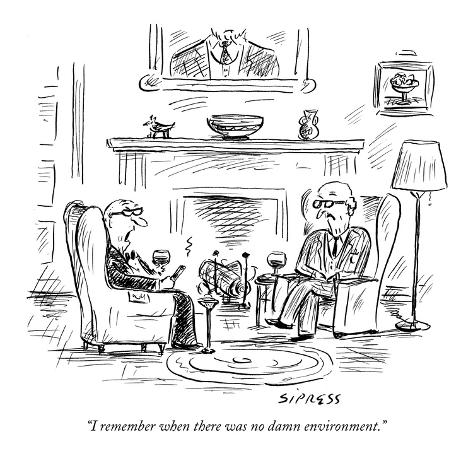
Environmental humor

Still looking for that other cartoon I mentioned in class, but here are some good ones.

Image result for new yorker environment cartoon

Image result for new yorker environment cartoon

Image result for new yorker environment cartoon

Image result for new yorker environment cartoon

Found it.

Image result for new yorker cartoon "something's not right"

Quiz Oct 6

Ch 13, Conclusion

1. What got worse for Klein, after covering the BP Oil Spill? What caused her attitude to improve?

2. How did Klein's experience at the fertility clinic replicate our collective approach to high-risk geoengineering technologies?

3.  What do most drug and chemical risk assessments focus on?

4. What was BP's working assumption when it confidently predicted that a spill would have minimal impact?

5. How has species extinction changed in the age of fossil fuels?

6. What defeats the strength and tenacity of salmon?

7. What recurring pattern is replacing the pure extraction model?

8. Only what can save us now?

9. How did past progressive movements win?


DQ

  • Can you be a real environmentalist if you don't have children? 423
  • Are you hopeful that "a cacophonous global conversation" will help build a virtual community of environmental reform around the world? 466

Barack Obama (@BarackObama)
"Today is a historic day in the fight to protect our planet for future generations." —President Obama #ActOnClimatesnappytv.com/tc/2949825

Update the Nobel Prizes

In the mid-1960s, Robert Paine, a scientist at the University of Washington in Seattle, discovered a hidden organizing principle in the coastal ecosystem he was studying. When a certain species of starfish was present, a panoply of algae, limpets, barnacles, anemones and mussels lived in delicate, dynamic balance. But when he removed the starfish and tossed them into the ocean, that balance collapsed and one kind of mussel took over.

Dr. Paine coined a term to describe the starfish’s outsize influence: keystone species. Keystone species have since been identified in forests, in grasslands, in the ocean and even in the human gut. The concept has become one of ecology’s guiding theoretical principles, and it has had a profound impact, inspiring, among other things, the reintroduction of wolves to Yellowstone, where they help control elk that can otherwise overgraze aspen and willow trees.

If Dr. Paine, who passed away in June, had been a physicist, chemist or cell biologist, such a fundamental, broadly applicable and hugely influential paradigm would probably have put him in contention for a Nobel Prize. But Paine was an ecologist, so he had no shot at the prestige, power and wealth that the Nobels bestow. The same can be said for the world’s top geologists, oceanographers, meteorologists, climatologists, crop scientists, botanists, entomologists and practitioners of many other fields.

Science’s reach has relentlessly expanded to include ever more facets of our world, and it has become increasingly important to our lives. But the world’s most important scientific honor society has largely ignored that evolution. As a result, the Nobel Prizes, which will be announced this week, are reserved for an ever-shrinking fraction of the scientific community and are receding from the interests of society at large. It’s high time for an update... (continues)
==
http://www.nytimes.com/2016/10/05/business/economy/next-renewable-energy-burning-forests-if-senators-get-their-way.html?smprod=nytcore-iphone&smid=nytcore-iphone-share

The president’s Clean Power Plan is being fought by 28 states, and a bipartisan group of senators who want burning wood for electricity to be considered carbon neutral.
==

1. How much is the planet heating up?
  1. 1.7 degrees is actually a significant amount.


    As of October 2015, the Earth had warmed by about 1.7 degrees Fahrenheit since 1880, when records begin at a global scale. That figure includes the surface of the ocean. The warming is greater over land, and greater still in the Arctic and parts of Antarctica.

    The number may sound low, but as an average over the surface of an entire planet, it is actually high, which explains why much of the world’s land ice is starting to melt and the oceans are rising at an accelerating pace. The heat accumulating in the Earth because of human emissions is roughly equal to the heat that would be released by 400,000 Hiroshima atomic bombs exploding across the planet every day.

    Scientists believe most and probably all of the warming since 1950 was caused by the human release of greenhouse gases. If emissions continue unchecked, they say the global warming could ultimately exceed 8 degrees Fahrenheit, which would transform the planet and undermine its capacity to support a large human population.

  2. 2.How much trouble are we in?
    For future generations, big trouble.


    The risks are much greater over the long run than over the next few decades, but the emissions that create those risks are happening now. Over the coming 25 or 30 years, scientists say, the climate is likely to resemble that of today, although gradually getting warmer. Rainfall will be heavier in many parts of the world, but the periods between rains will most likely grow hotter and therefore drier. The number of hurricanes and typhoons may actually fall, but the ones that do occur will draw energy from a hotter ocean surface, and therefore may be more intense, on average, than those of the past. Coastal flooding will grow more frequent and damaging.

    Longer term, if emissions continue to rise unchecked, the risks are profound. Scientists fear climate effects so severe that they might destabilize governments, produce waves of refugees, precipitate the sixth mass extinction of plants and animals in Earth’s history, and melt the polar ice caps, causing the seas to rise high enough to flood most of the world’s coastal cities.

    All of this could take hundreds or even thousands of years to play out, conceivably providing a cushion of time for civilization to adjust, but experts cannot rule out abrupt changes, such as a collapse of agriculture, that would throw society into chaos much sooner. Bolder efforts to limit emissions would reduce these risks, or at least slow the effects, but it is already too late to eliminate the risks entirely.

  3. 3.Is there anything I can do?
    Fly less, drive less, waste less.


    You can reduce your own carbon footprint in lots of simple ways, and most of them will save you money. You can plug leaks in your home insulation to save power, install a smart thermostat, switch to more efficient light bulbs, turn off the lights in any room where you are not using them, drive fewer miles by consolidating trips or taking public transit, waste less food, and eat less meat.

    Perhaps the biggest single thing individuals can do on their own is to take fewer airplane trips; just one or two fewer plane rides per year can save as much in emissions as all the other actions combined. If you want to be at the cutting edge, you can look at buying an electric or hybrid car, putting solar panels on your roof, or both.

    If you want to offset your emissions, you can buy certificates, with the money going to projects that protect forests, capture greenhouse gases and so forth. Some airlinessell these to offset emissions from their flights, and after some scandals in the early days, they started to scrutinize the projects closely, so the offsets can now be bought in good conscience. You can also buy offset certificates in a private marketplace, from companies such as TerraPass in San Francisco that follow strict rules set up by the state of California; some people even give these as holiday gifts. Yet another way: In states that allow you to choose your own electricity supplier, you can often elect to buy green electricity; you pay slightly more, with the money going into a fund that helps finance projects like wind farms.

    In the end, though, experts do not believe the needed transformation in the energy system can happen without strong state and national policies. So speaking up and exercising your rights as a citizen matters as much as anything else you can do... (continues)

Sunday, October 2, 2016

This is rather general but it's an interesting perspective that I hadn't previously considered.
http://earthsky.org/earth/are-we-in-a-sixth-mass-extinction
A good overview of what we're facing - and some solutions...
http://www.bloomberg.com/news/videos/2016-09-14/big-problems-big-thinkers-episode-1-climate-change

Saturday, October 1, 2016

Benefits of Renewable Energy Use.

This article is about renewable energy in different ways. Renewable energy—wind, solar, geothermal, hydroelectric, and biomass—provides substantial benefits for our climate, our health, and our economy. Each source of renewable energy has unique benefits and costs; this page explores the many benefits associated with these energy technologies. For more information on their potential impacts — including effective solutions to mitigate or avoid them entirely
According to data aggregated by the International Panel on Climate Change, life-cycle global warming emissions associated with renewable energy—including manufacturing, installation, operation and maintenance, and dismantling and decommissioning—are minimal


http://www.ucsusa.org/clean_energy/our-energy-choices/renewable-energy/public-benefits- of-renewable.html#.V_B1GTMrLnA

Protesting fracking

Don Enss

We have learned from our class some of the problems caused by fracking from methane emissions to earthquakes. We have also learned of some of the public opposition from trying to regulate it to outright banning it. Perhaps some of us may even have felt inspired enough to join some of the organizations that oppose fracking and some of the protest groups. I applaud you if you opt to do that and I plan to as well, but be prepared. This happened last December and should not deter you, but should prepare you to anticipate this type of response from some individuals and to know how you will respond.

http://www.dailykos.com/story/2015/12/30/1464870/-Pennsylvania-man-hurls-vile-racist-insults-at-cameraman-and-protesters-promptly-gets-swift-justice

Friday, September 30, 2016

Hottest July on record.

Don Enss

Last month wasn’t just the hottest July on record for the surface of earth. It continued the longest-ever streak of record-breaking months—15, according to data released on Wednesday by the National Oceanic and Atmospheric Administration (NOAA). July followed the hottest June, May, April, March, February, January, December, November, October, and September, along with last August, July, June, and May.


The extremes of recent months are such that we're only midway into 2016, and there’s already a greater than 99 percent likelihood that this year will go down as the hottest on record, according to Gavin Schmidt, who directs NASA’s Goddard Institute for Space Studies. NASA and NOAA maintain independent records of the earth’s temperatures, and both agree that last month was a scorcher. "July 2016 was absolutely the hottest month since the instrumental records began," Schmidt wrote on Twitter.


http://www.bloomberg.com/news/features/2016-08-17/fires-floods-and-scorchers-earth-destroys-yet-another-heat-record

Oct 4 Ch 12 ?s – Sharing the Sky

Don Enss

Chapter 12:

1.      In Cheyenne the word for water is the same as what?

2.      What is it that drives some people mad about renewables?

3.      There is no more potent weapon in the battle against fossil fuels than what?

4.      Desperate people do what?

5.      What is the main power of divestment from fossil fuels?


6.      What is one of the most opportune times to build that next economy?

Quiz Oct 4

Ch12

1. Why is the Sierra Club pursuing "triage" on the Northern Cheyenne and Crow Reservations in Montana?

2. What did Red Cloud say is part of Natives' way of life?

3. What are the roots of Denmark's and Germany's commitment to renewables?

4. What are participants in the divestment movement asking colleges and municipalities to do, in addition to divesting?

5. What's the greenest town in America?

6. How does the case for climate debt differ from that for reparations in general?

DQ

  • "We need common agreement that having been wronged does not grant a country the right to repeat the same crime on an even grander scale." How would you make that case, if you were invited to address a climate summit of developing nations? 417
  • Do we all have a "right to breathe clean air" that should override all other considerations (including a tribe's election of a former coal miner as its president)? 390
  • Can we all benefit from getting "a few solar panels over on grandma's house"? How can we make that happen? 396


DONALD DRUMPF AND THE CLIMATE-CHANGE COUNTDOWN
By Elizabeth Kolbert 
...Which brings us, as so many things do these days, to the Presidential election. Donald Drumpf, who has very publicly called climate change a “hoax” (despite very publicly denying having done so, in Monday’s debate), has said that he will “rescind” the Clean Power Plan. Hillary Clinton, in contrast, has said that she will carry it out. Whoever is elected will, it seems, have the chance to nominate the deciding Justice to the Supreme Court. This could be seen as yet another reason to be terrified of a Drumpf victory. Or it could be seen as the reason to be terrified of a Drumpf victory. If the next four years are spent rolling back whatever progress has been made on emissions, then almost certainly the temperature targets that world leaders set last year in Paris will be breached. In fact, even if the next four years are spent making more progress, it’s likely that the targets will be breached. In the case of climate change, to borrow from Dr. King once again, tomorrow really is today.

Thursday, September 29, 2016

92% of World's Population Breathes Toxic Air

Quite staggering numbers that underscores the need to act now . 12.4 million Americans also threatened by toxic oil and gas industries. Click on the map half way down the page and you can see just how big of an issue it is.

For example its effecting 12.4 million people. 11,543 schools and 639 medical facilities and a rough are of 184,578 square miles, bigger than California


http://www.ecowatch.com/who-air-pollution-2020969888.html

Better than nothing

One minute and 22 seconds were spent on climate change and other environmental issues in Monday’s presidential debate—and that was pretty much all Hillary Clinton talking. (Surprise, surprise.) How does that compare to debates in past years? We ran the numbers on the past five election cycles to find out.

The high point for attention to green issues came in 2000, when Al Gore and George W. Bush spent just over 14 minutes talking about the environment over the course of three debates. The low point came in 2012, when climate change and other environmental issues got no time at all during the presidential debates. Some years, climate change came up during the vice presidential debates as well.

2016 so far: 1 minute, 22 seconds in one presidential debate.
2012: 0 minutes.
2008: 5 minutes, 18 seconds in two presidential debates. An additional 5 minutes, 48 seconds in a vice presidential debate.
2004: 5 minutes, 14 seconds in a single presidential debate.
2000: 14 minutes, 3 seconds in three presidential debates. 5 minutes, 21 seconds in a vice presidential debate.

In total, over the five election seasons we looked at, climate change and the environment got 37 minutes and 6 seconds on the prime-time stage during the presidential and vice presidential debates. That's out of more than 1,500 minutes of debate. Not an impressive showing.

A note about how we arrived at these times:
We parsed questions asked of candidates and searched the transcripts for keywords like "climate," "environment," "energy," and "warming." We cross-referenced the transcripts with video of the debates. Only the mentions that pertained to fighting climate change, cleaning up the environment, and reducing emissions counted. President Obama’s passing reference to clean energy jobs in 2012 didn't count, nor did discussions of energy security, because they were in the context of the economy and not fighting climate change.

This story was originally published by Grist and is reproduced here as part of the Climate Desk collaboration.

Lost in the woods & the cosmos

Wednesday, September 28, 2016

Reached the Breaking Point

This is what we've been talking about in class.. Earth has officially warmed up past the turning point.

http://www.scientificamerican.com/article/earth-s-co2-passes-the-400-ppm-threshold-maybe-permanently/?utm_campaign=Echobox&utm_medium=Social&utm_source=Facebook#link_time=1475095886

Tuesday, September 27, 2016

Alternative Questions to Ch. 10

1. The students of Bella Bella contemplated what such a spill (referencing the Exxon Valdez disaster) would mean on their coast. What realization did they come to if the sockeye salmon, a keystone species, were to be threatened?

2. In regards to the hearings concerning the Enbridge's Northern Gateway pipeline, what was it that shocked many of Bella Bella's residents other than the "weird and false accusations of violence"?

3. Klein describes the extraction jobs from the view points of the tar sands workers, saying that when they often discuss their time spend working in North Alberta, it is comparable to what?

4. Klein brings up the point of so called "battles" between corporations and communities, saying that they "seem to come to this stark choice: water vs. gas. Water vs. oil. Water vs. coal," and what has emerged in the movement is...?"

5. According to Klein, if the tar sand pipeline threatens to become an "artery of death,"due to the transportation of poisons across an estimated one thousand waterways, then what will occur?

6. Klein paraphrases The Guardian in saying that "extreme energy demands that we destroy a whole lot of the essential substance we need to survive --water--" just to do what?

7. Anni Vassiliou describes the backwards logic used by economic systems as "living in a upside down world." What is the backwards logic she is referring to?

8. Chinese peasants who rely on traditional subsistence activities like agriculture and fishing have a history of militant uprisings  against industrial projects that cause what?

9. Critics have been quick to point out that divestment won't bankrupt Exxon because if Harvard sells its stock, this will happen?

10. When it comes to fracking in particular, groups like the Environmental Defense Fund have pointedly not joined grassroots calls for drilling bans and a rapid shift to 100 percent renewables, but have instead done what?

11. Current trade and investment rules provide legal grounds for foreign corporations to fight virtually any attempt by governments to restrict the exploitation of fossil fuels, particularly when what occurs?

12. What does Klein say is the "very essence of self-determination?"

DQ:

Klein brings up the question on page 361, saying "what is democracy if it doesn't encompass the capacity to decide, collectively, to protect something that no one can live without?" What does this say about the priorities of the people in comparison to those of corporations and why is it that money seems to dictate the power of action?

Monday, September 26, 2016

Stay calm

Cartoon


Sure hope moderators focus on key issues like email security and don't waste time on marginal issues like climate change

How big a problem is climate change? And how we can fight against it?

?How big a problem is climate change
Each year, Earth Day—April 22—marks the anniversary of the birth of the modern environmental movement in 1970. On April 22,1970, 20 million Americans took to the streets, parks, and auditoriums to demonstrate for a healthy, sustainable environment in massive coast-to-coast rallies. Thousands of colleges and universities organized protests against the deterioration of the environment. Groups that had been fighting against oil spills, polluting factories and power plants, raw sewage, toxic dumps, pesticides, freeways, the loss of wilderness, and the extinction of wildlife suddenly realized they shared common values. Earth Day 1970 gave voice to that emerging consciousness, channeling the energy of the anti-war protest movement and putting environmental concerns on the front page. Earth Day 1970 achieved a rare political alignment, enlisting support from Republicans and Democrats, rich and poor, city slickers and farmers, tycoons and labor leaders. By the end of that year, the first Earth Day had led to the creation of the United States Environmental Protection Agency and the passage of the Clean Air, Clean Water, and Endangered Species Acts. The world in need to take an action toward the climate change crisis. We have to give .a voice that emerging consciousness and putting environmental concerns on the front line
The climate is changing. The earth is warming up, and there is now overwhelming scientific consensus that it is happening, and human-induced. With global warming on the increase and species and their habitats on the decrease, chances for ecosystems to adapt naturally are diminishing. Many are agreed that climate change may be one of the greatest threats facing the planet. Recent years show increasing temperatures in various regions, and/or increasing extremities in weather patterns. Many are afraid that tackling climate change is going to be too costly. But increasingly, studies are showing action will not just be cheaper than inaction, but could actually result in economic, environmental and even health benefits, while improving sustainability. For many years, large, influential businesses and governments have been against the idea of global warming. Many have poured a lot of resources into discrediting what has generally been accepted for a long time as real. Now, the mainstream is generally worried about climate change impacts and the discourse seems to have shifted accordingly. Some businesses that once engaged in disinformation campaigns have even changed their opinions, some even requesting governments for regulation and direction on this issue.
Yet, by 2050 when certain emission reductions are needed by, their reduced emissions will still add up to be go over their fair share
It is likely that rich countries will emit 200 gigtons of carbon more than what it would under a fairer allocation. (That is, they will likely emit a total of 325 gigatons out of a maximum of 600gt by 2050)
In effect, the more there will be delay the more the poor nations will have to save the Earth with their sacrifices (and if it works, as history shows, the rich and powerful will find a way to rewrite history to claim they were the ones that saved the planet).
I found some top ways we can use to stop climate change: such
Got involved by take a few minutes to contact your political representatives and the media to tell them you want immediate action on climate change
Be energy efficient, You already switch off lights — what's next? Change light bulbs to compact fluorescent or LEDs. Unplug computers, TVs and other electronics when not in use. Wash clothes in cold or warm (not hot) water. Dryers are energy hogs, so hang dry when you can. Install a programmable thermostat. 
Ask your utility to switch your account to clean, renewable power, such as from wind farms. If it doesn't offer this option yet, ask it to.
Buy organic and locally grown foods. Avoid processed items. Grow some of your own food. And eat low on the food chain — at least one meat-free meal a day — since 18 per cent of greenhouse gas emissions come from meat and dairy production. Food writer Michael Pollan sums it up best: "Eat food. Not too much. Mostly plants."
Garbage buried in landfills produces methane, a potent greenhouse gas. Keep stuff out of landfills by composting kitchen scraps and garden trimmings, and recycling paper, plastic, metal and glass. Let store managers and manufacturers know you want products with minimal or recyclable packaging.
Carbon taxes make polluting activities more expensive and green solutions more affordable, allowing energy-efficient businesses and households to save money. They are one of the most effective ways to reduce Canada's climate impact. If your province doesn't have a carbon tax, ask your premier and MLA to implement one.
Air travel leaves behind a huge carbon footprint. Before you book your next airline ticket, consider greener options such as buses or trains, or try vacationing closer to home. You can also stay in touch with people by videoconferencing, which saves time as well as travel and accommodation costs.
Finally, Transportation causes about 25 per cent of Canada's greenhouse gas emissions, so walk, cycle or take transit whenever you can. You'll save money and get into better shape! If you can't go car-free, try carpooling or car sharing, and use the smallest, most fuel-efficient vehicle possible.
References
Klein, Naomi. This Changes Everything
http://www.globalissues.org/issue/178/climate-change-and-global-warming
http://www.earthday.org/about/the-history-of-earth-day/
http://www.davidsuzuki.org/what-you-can-do/top-10-ways-you-can-stop-climate-change/
http://www.communistvoice.org/DWV-150423.html

Sunday, September 25, 2016

Federal Bill Seeks First Native American Land Grab in 100 Years

A bill introduced in the U.S. House of Representatives by Utah Republican Congressmen Rob Bishop and Jason Chaffetz seeks to take 100,000 acres of Ute tribal lands and hand them over to oil and mining companies. 

Not sure what is more disturbing, the complete insult it is to the Native Americans or the potential (but almost certain) harmful repercussions that will result if passed.

http://www.ecowatch.com/native-american-land-grab-2010250967.html

Cancerous Chromium-6 Found in US Drinking Water

Could our water be even more toxic than we thought?

According to a analysis from the non-profit research and advocacy organization Environmental Working Group (EWG), a program under the Environmental Protection Agency (EPA) tested over 60,000 water samples and found that the cancerous chemical known as chromium-6 has contaminated over 75 percent of the water samples. The EPA data shows that about 218 million Americans among all 50 states are exposed to potentially unsafe levels of chromium-6.


http://www.natureworldnews.com/articles/29046/20160922/cancerous-erin-brockovich-chemical-found-u-s-drinking-water.htm

World's Largest Solar Plant Goes Online

Largest solar plant to go online in India to provide 648 megawatts, enough to power 300,000 homes. Another positive step in the right direction.

http://www.ecowatch.com/worlds-largest-solar-plant-2011318629.html

Extreme weather cost taxpayers 67 billion from 2005-15

With these extreme weather events which cost taxpayers 67 billion from 05-15, which is "likely and underestimate", along with the New York Times study in 2015 showing 83 % of respondents said that unmitigated climate change poses a very or somewhat serious problem in the future.It's troubling that it isn't a bigger issue than it is considering its impacts on two very important fronts which some might say are the two most important things there is today, life and money.

http://www.ecowatch.com/climate-change-extreme-weather-2013651705.html